U.N. General Assembly demands Russia return 20,000 deported Ukrainian children as reports show transfers to North Korea
The U.N. General Assembly adopted a resolution by a majority vote demanding that the Russian Federation immediately and unconditionally return all illegally deported Ukrainian children.
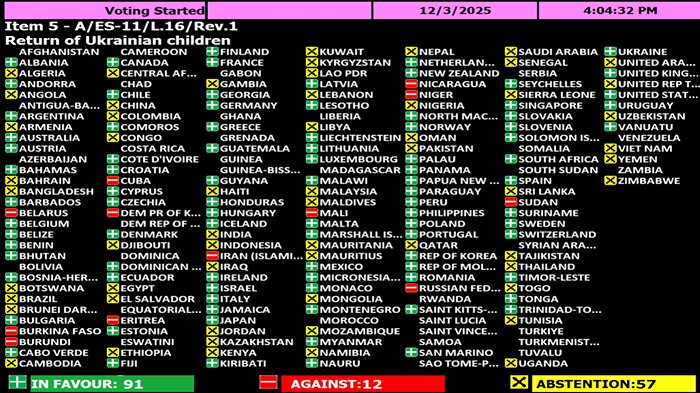 Voting resultes
The General Assembly demanded that Russia ensure the immediate, safe, and unconditional return of Ukrainian children who were unlawfully transferred or deported.
The document further “calls on the Russian Federation to immediately cease any further practice of forced transfer, deportation, separation of children from their families and legal guardians, alteration of personal status, including through citizenship, adoption, or placement in foster families, and the indoctrination of Ukrainian children.”
91 countries supported the resolution. Twelve states voted against it, and 57 abstained.
Russia, Belarus, Iran, Nicaragua, Cuba, Eritrea, Mali, and several other states voted against the resolution.
Fifty-seven states abstained from voting, including China, India, Brazil, Armenia, Kazakhstan, Kyrgyzstan, Uzbekistan, Egypt, Qatar, and Pakistan.
Presenting the document, Ukrainian Deputy Foreign Minister Mariana Betsa explained that the resolution is not about politics, but exclusively about humanity and the moral obligation of the international community.
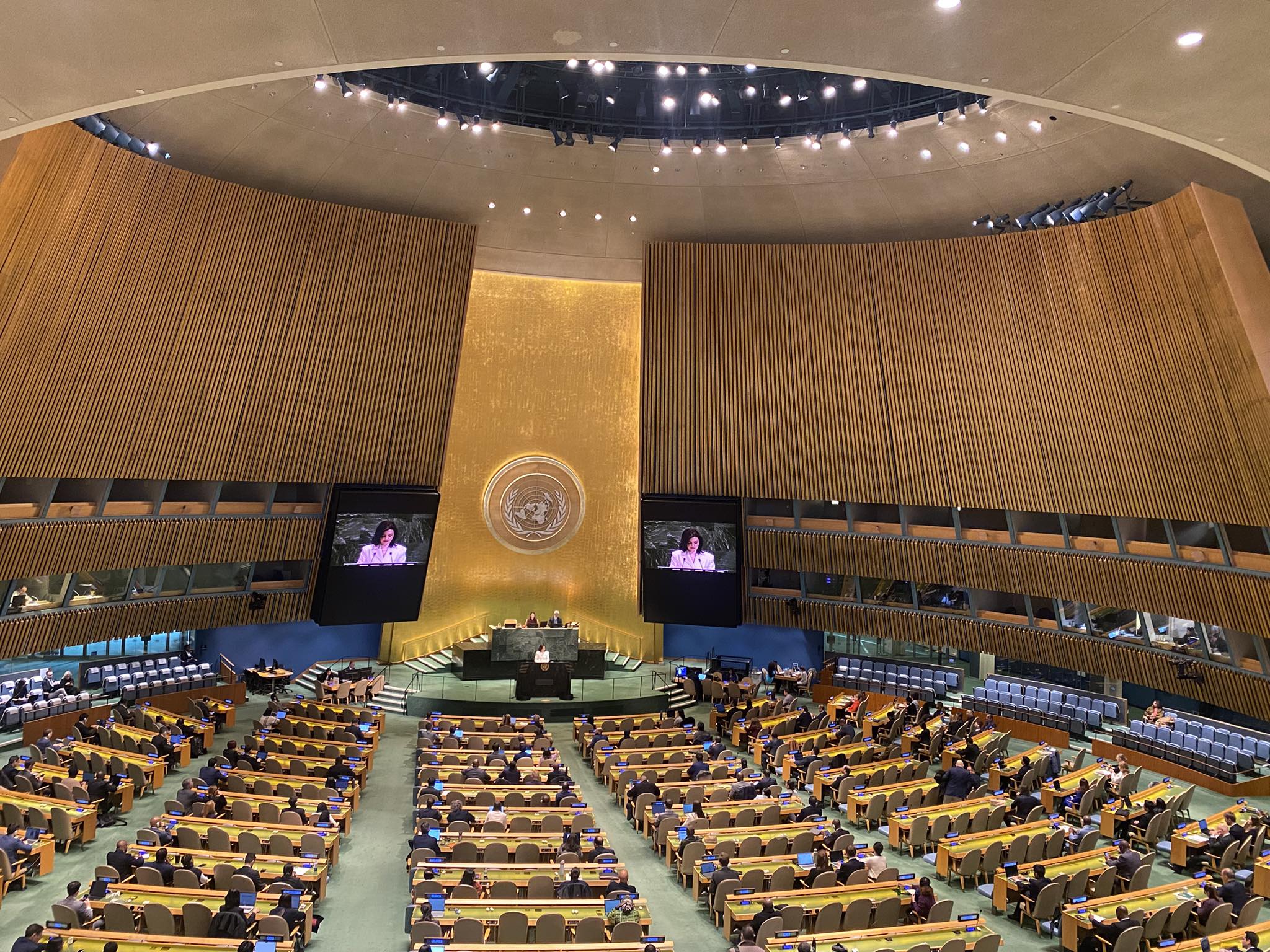
She stated that Russia’s war against Ukraine has made children the most vulnerable target of aggression. According to the diplomat, Russia is not only killing and maiming children but also attempting to erase their identity.
Betsa stressed that in the occupied territories and in Russia, Ukrainian children are denied their native language, literature, and history, and are instead subjected to hostile propaganda. Children are forced to repeat fake narratives about a “Nazi state” and are recruited into so-called “children’s armies,” where they undergo “military training and ideological indoctrination.”
In addition, she underlined that Russia has deported at least 20,000 Ukrainian children to date. Ukraine has so far managed to return only 1,850 of them.
U.N. General Assembly President Annalena Baerbock, during the review of the draft, emphasized that the deportation of children is a gross violation of international humanitarian law.
She reminded countries, including the aggressor state, that Article 49 of the Fourth Geneva Convention prohibits the forcible transfer of civilians from occupied territories under any circumstances. Likewise, the Convention on the Rights of the Child guarantees every child’s right to identity, family life, nationality, and protection from abduction.
Baerbock stressed that the issue of returning children cannot be viewed separately from the fact of the Russian invasion. She noted that the General Assembly is acting consistently in conditions where the U.N. Security Council remains unable to make decisions due to Russia’s position.
Diplomats emphasized that support for the resolution is a vote for international law and justice, as it creates tools for the abducted children to live on their native land again.
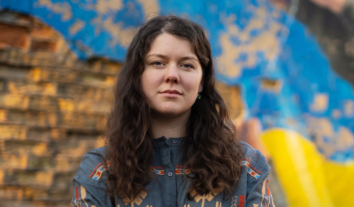
Meanwhile, Kateryna Rashevska, an expert on international justice and legal analysis at the Regional Center for Human Rights (RCHR), during a U.S. Senate hearing on December 3, stated that Russian occupying forces are illegally transferring Ukrainian children from temporarily occupied territories to so-called “reeducation camps” not only in Russia and Belarus but also in North Korea.
According to Rashevska, RCHR has documented the existence of 165 “reeducation” camps. In these facilities, Ukrainian children are subjected to forced militarization and Russification.
During the testimony of the human rights advocate, she demonstrated photographs of Ukrainian children who ended up in North Korea. She specifically mentioned 12-year-old Mykhailo from the occupied part of the Donetsk region and 16-year-old Liza from the temporarily occupied city of Simferopol.
 Kateryna Rashevska, a lawyer for the **Regional Center for Human Rights**. U.S. Senate/ Screenshot
She pointed out that these children were sent to the Songdowon camp, located 9,000 kilometers (about 5,600 miles) from their homes.
“In this camp, children were taught to destroy Japanese military personnel and were introduced to Korean veterans who attacked the American ship USS Pueblo in 1968, killing and wounding nine American soldiers,” cites Rashevska Suspilne news broadcaster as saying.
The expert noted that Russia officially calls the removal of Ukrainian children an “evacuation.” However, under international humanitarian law, such a procedure has clear limitations and obligations that the aggressor country is not upholding.
Specifically, the law requires the occupying power to take all possible measures to reunite families. Furthermore, Russia was obligated to provide lists of the abducted children to the International Committee of the Red Cross.
You may also want to read: Ukraine refutes Russia’s claims of “fully processing” list of abducted children
Rashevska stressed that evacuation is intended to be exceptional and temporary. The Russian Federation must regularly assess the security situation and immediately return the children as soon as the grounds for their transfer no longer exist.
The lawyer stated that Russia has not fulfilled any of these obligations.
Updated: Time Magazine, in its Review 2025, pointed out that the abduction of Ukrainian children is nothing new. It also occurred during Russia’s 2014 invasion of the Crimean Peninsula.
The Humanitarian Research Lab at Yale University has been tracking the children through Russian news reports, public databases, and social media posts. In March, the group succeeded in identifying more than 8,400 children who had been “systematically relocated” from Ukraine.
Moscow sometimes used military transport planes to take the children, who were then assigned to Russian foster families. As Nathaniel Raymond, executive director of the Yale group, told the Guardian, “This is likely the largest child abduction in war since World War II, comparable to the Germanification of Polish children by the Nazis.” The fear is that the children will vanish into Russia’s adoption system, homes, and reeducation camps.
The Times of London has reported that there’s evidence Russia has forcibly conscripted some of the children to fight against their homeland when they turn 18.
Earlier, ZMINA reminded that the Special Tribunal for the Crime of Aggression against Ukraine will become a global mechanism — countries in Latin America, Africa, and Asia are invited to join it. Ukraine is finalizing the treaty for an international committee that will govern the tribunal and influence its operations, including the appointment of judges, according to Dr. Anton Korynevych, Director of the International Law Department of the Ministry of Foreign Affairs of Ukraine.
Join our community on X and LinkedIn, and while you’re reading, let us know how we can serve you better – take our feedback survey here.