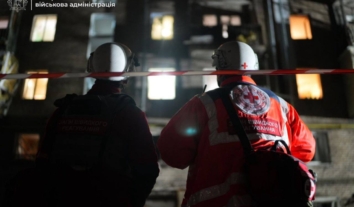
Russian attack on Kherson ambulance kills driver, injures two healthcare workers
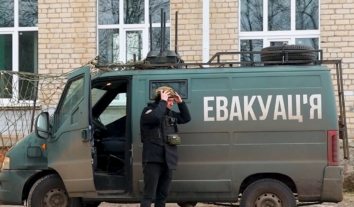
Russian armed forces attacked an ambulance in the centre of the city of Kherson on the evening of June 2, 2025, killing the driver, according to Oleksandr Prokudin, Head of the Kherson Oblast Military Administration and the Kherson Oblast Prosecutor’s Office.


The attack took place at around 17:00.
The 68-year-old driver sustained fatal injuries. The Russian attack also injured two healthcare workers, a 53-year-old man and a 59-year-old woman.
According to the prosecutor’s office, during the day, 11 people were reported to have been injured in Kherson, Antonivka, Bilozerka and Stanislav, including a five-year-old child.


The Russians shelled Kherson with artillery at around 04:00. A 40-year-old man sustained fatal injuries.
Russians were also killed in their artillery on Kherson’s Korabelnyy district on the morning of June 2, killing a local resident and injuring a 5-year-old boy. He suffered a blast injury and concussion in the attack. He is in the hospital under medical supervision.
On May 31, Prokudin reported that a 66-year-old man was killed in a nighttime Russian attack on the Dniprovskyy District of the city of Kherson. Prokudin later added in his report for the past that day that three people had been killed and another ten injured in the Kherson Oblast as a result of Russian aggression.
By way of background, Russian army personnel frequently target civilians in the Kherson Oblast with drone attacks. Local authorities regularly report casualties caused by explosives dropped from drones. Previously, the Financial Times reported that Russia may be using these strikes to train operators of kamikaze drones.
Previously, the Independent International Commission of Inquiry on Ukraine released a report, in which the commission concluded that Russian armed forces have committed murder of civilians as crimes against humanity and war crimes using drones.
The Commission pointed out that from July 2024, Russian forces have recurrently killed and injured civilians in an area stretching over more than 100 kilometres along the right bank of the Dnipro River in Kherson Province.
The Commission examined over 300 publicly available videos of attacks and over 600 text posts on Telegram channels and, where possible, identified victims of these attacks. It interviewed 91 persons from the areas affected by drone attacks, including victims, witnesses, local authorities and medical personnel.
The drone attacks have been widespread, systematic and conducted as part of a coordinated state policy, the report said.
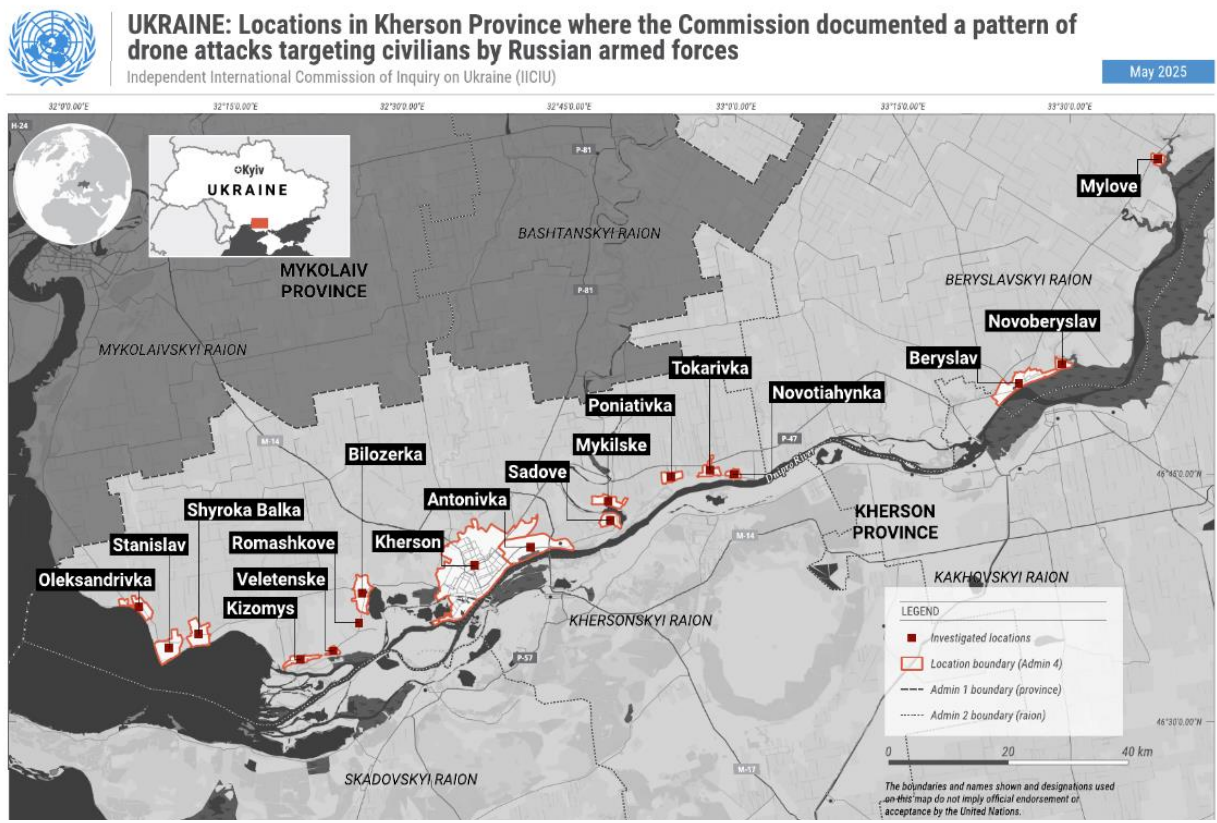
The attacks followed a regular pattern and the same modus operandi, demonstrating that they were planned, directed, and organized. There is no information suggesting that Russian military and civilian authorities have taken any steps to prevent or stop the commission of the crimes, the Commission stressed in its report.
Nearly 150 civilians have been killed and hundreds more injured as a result of the drone attacks in Kherson city and 16 localities in the Ukrainian-controlled areas, according to official sources. Victims were men, women, and children, mostly men. Civilians were targeted in various circumstances, as they stepped out to carry out their daily activities, whether on foot or in any type of vehicle.
The drone operators used video feeds transmitted in real time by the cameras embedded in the drones, focused on targets that were visibly civilian, and dropped explosives on them. Hundreds of these video feeds have been regularly disseminated on Russian Telegram channels, some of them with thousands of subscribers, displaying the crimes, as well as text posts announcing further attacks.
The Commission pointed out that the drone attacks caused deaths, grave bodily injuries, including amputations, cuts and concussions, and also led to psychological trauma and fear.
Ambulances, which have special protection under international law, have been targeted and struck by drones, so as to prevent them from reaching victims who had been previously attacked. Some of these victims have died as a consequence of not being moved to a medical facility in time.
A 45-year-old man from Stanislav village recounted that in November 2024, a drone dropped an explosive near him as he was riding a moped, badly injuring his leg. An ambulance arrived, and while he was receiving first aid, a drone dropped two explosives on the ambulance.
The Independent International Commission of Inquiry on Ukraine stated that the use of drones to target civilians and civilian objects is a violation of the fundamental principle of international humanitarian law, according to which attacks may only be directed at military objects.
“The evidence collected leaves no doubt that the perpetrators intended to carry out these acts. The Commission, therefore, concludes that the Russian armed forces perpetrated the war crime of intentionally directing attacks against civilians in Kherson Province. It also finds that posting videos of civilians being killed and injured amounts to the war crime of outrages upon personal dignity”, the Commission stated in its report.
It also highlighted that the civilian population in the areas affected by drone attacks lives in constant fear. Residents take risks every time they go outside, as they fear being struck by drones. Many wait for cloudy days to go out, or seek cover under trees, where possible. Fear is further induced by frequent messages posted on Telegram, such as “Get out of the city before the leaves fall, you who are destined to die.”
The circumstances of the attacks, the videos, and the explicit threatening text posts demonstrate that Russian armed forces and those supporting them have committed acts or threats of violence for the primary purpose of spreading terror among the civilian population, in violation of international humanitarian law.
Referring to Russian soldiers, a senior health professional of a hospital in Kherson said:
“They are simply chasing and hunting civilians who are on their way to work or walking their dogs. They drop explosives from drones like it is a video game.”
The Commission explained that the scale and intensity of the drone attacks against civilians and civilian objects as well as the destruction of houses and basic infrastructure, the targeting of all means of transport, and attacks against emergency and rescue services, have all rendered the affected areas unliveable and left many residents with no other choice than to flee.
“The recurrent drone attacks, the widely disseminated videos showing them, and numerous posts explicitly exhorting the population to leave suggest a coordinated state policy, on the part of the Russian authorities, to force the population of Kherson Province to leave the area. The Commission, therefore, concludes that the Russian armed forces may have committed the crime against humanity of forcible transfer of population,” the Commission concluded.
The UN Independent International Commission of Inquiry on Ukraine is an independent body mandated by the UN Human Rights Council to investigate all alleged violations and abuses of human rights, violations of international humanitarian law, and related crimes in the context of the Russian Federation’s aggression against Ukraine. The Commission comprises Erik Møse (Chair), Pablo de Greiff, and Vrinda Grover.
The Commissioners were appointed by the President of the UN Human Rights Council; they are not UN staff and do not receive a salary for their work. While the UN Human Rights Office provides support to the Commission of Inquiry, the commissioners serve in their individual capacity and are independent from any government or organization, including the UN. Any views or opinions presented herein are solely those of the mandated commissioners.