Most Ukrainians see Russia’s war as an attempt at genocide and the destruction of the Ukrainian nation
Most respondents in Ukraine (69%) believe that through its war, Russia seeks to commit genocide or destroy the Ukrainian nation and statehood. These findings come from a survey conducted by the Kyiv International Institute of Sociology (KIIS).
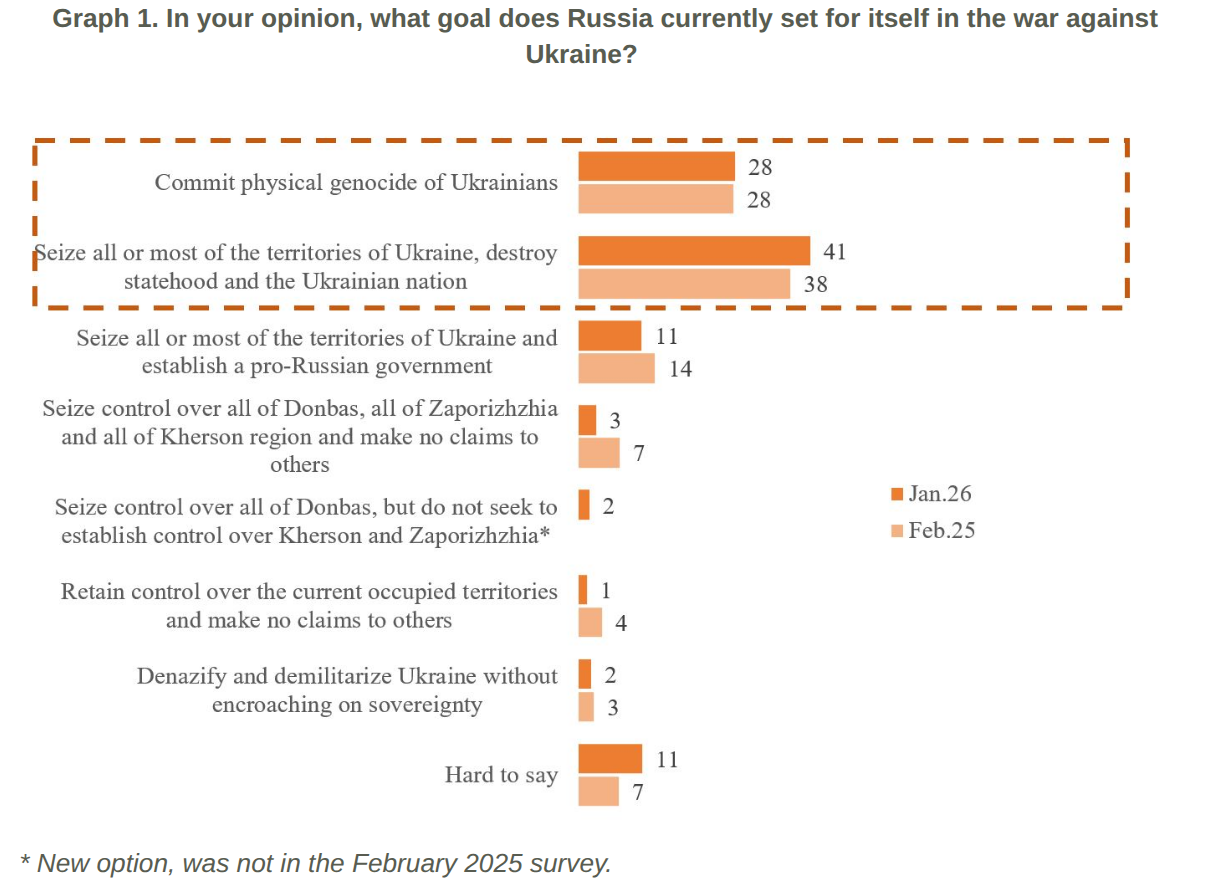
Sociologists periodically examine how Ukrainians perceive Russia’s aggression, enabling tracking of changes in public sentiment over time.
Almost a year ago, in February 2025, 66% of respondents agreed that Russia’s goal in Ukraine is genocide or the destruction of Ukrainian statehood and Ukrainians as a nation. Since then, the share of those holding this view has increased slightly to 69%.
The proportion of respondents who believe that Russia’s aim is to seize the entirety of Ukraine declined from 14% to 11%, while those who think Russia seeks only to maintain control over the territories it has already occupied decreased from 4% to 3%. At the same time, the share of respondents who find it difficult to define their perception of Russia’s aggression rose from 7% to 11%.
Two percent of respondents share the view that Russia currently aims to occupy the Donbas while not seeking control over the Zaporizhzhia and Kherson regions. The researchers noted that this question effectively reflects a scenario under discussion during negotiations.
At least 2% of respondents identify Russia’s main goal in the war as “demilitarization and denazification,” without encroaching on Ukraine’s sovereignty.
“If the majority believes that Russia wants to destroy the Ukrainian nation (or even commit genocide), this significantly narrows the range of solutions that could be acceptable to Ukrainians. Therefore, a cornerstone for Ukrainians is the configuration of security guarantees and the role of the West in providing them — especially given that Ukrainians expect Russia to attempt another attack anyway,” Anton Hrushetskyi, Executive Director of the Kyiv International Institute of Sociology, commented on the findings.
For reference: The KIIS conducted a survey via telephone interviewsі using a random sample of mobile phone numbers, with random number generation followed by statistical weighting, across all regions of Ukraine under government control between January 9 and 14, 2026. A total of 601 respondents aged 18 or older residing in government-controlled territory at the time of the survey were interviewed.
Residents of territories temporarily not under the control of the Ukrainian authorities were excluded from the sample, although some respondents were internally displaced persons who had moved from the occupied territories. The survey also did not include citizens who had left Ukraine after February 24, 2022.
Under normal circumstances, the statistical margin of error for such a sample, with a confidence level of 0.95 and taking into account a design effect of 1.3, does not exceed 5.3% for indicators close to 50%, 4.6% for indicators close to 25%, 3.2% for indicators close to 10%, and 2.4% for indicators close to 5%.
To provide background, following Russia’s full-scale invasion, at least 45% of surveyed Ukrainians reported a very negative attitude toward Russian citizens in general, while another 27% expressed a rather negative view. A majority share the opinion that the entire population of Russia bears equal responsibility for starting the war.
Cover photo: AP.