More than half of Ukrainians support banning Ukrainian Orthodox Church over Russia ties – poll
More than half of Ukrainians (57%) support banning the Ukrainian Orthodox Church due to its ties with Russia. Two-thirds of respondents (62%) support a law banning the activities of religious organisations affiliated with the aggressor state, according to the results of an all-Ukrainian survey, “Assessment of the Religious Situation in Ukraine”, conducted by the Rating Sociological Group, ZMINA reported.
The Rating Sociological Group surveyed 2,000 Ukrainians between 4 and 9 May 2026 on their assessment of the religious situation in Ukraine.
 Photo credit: the State Service of Ukraine for Ethnopolitics and Freedom of Conscience
According to the poll, 78% of respondents believe in God, 26% identify as Orthodox Christians in general, and 16% do not identify with any specific denomination. Among those surveyed, 22% identified with the Orthodox Church of Ukraine, headed by Metropolitan Epiphaniusі . 10% identified with the Ukrainian Orthodox Church, headed by Metropolitan Onufriy Berezovsky, and 7% with the Ukrainian Greek Catholic Church.
The survey shows that 61% of Ukrainians have a high level of trust in people of other religious denominations, while only 31% distrust followers of other faiths. In contrast, respondents exhibit higher levels of distrust toward individuals with different political views (60%) or of a different nationality (38%). Furthermore, 74% of respondents describe relations between believers of different faiths as friendly or peaceful in their local communities, compared to just 48% who feel this way about Ukraine as a whole.
“Ukrainians demonstrate the lowest social distance towards members of the Ukrainian Greek Catholic Church and the Orthodox Church of Ukraine. They are somewhat more reserved, yet still positive, in their attitudes towards followers of the Ukrainian Orthodox Church and Protestant churches. The greatest social distance is expressed towards Muslims and Jews,” said Oleksii Antypovych, Rating Group co-founder.
More than two-thirds of Ukrainians (68%) rate the country’s religious freedom as high, while 27% rate it as low. An overwhelming 88% of respondents said they had not experienced discrimination due to religious beliefs, either personally or through their families.
Two-thirds of Ukrainians (62%) support a law banning the activities of religious organisations affiliated with the aggressor state. The vast majority of respondents (80%) support the Ukrainian Orthodox Church (Moscow Patriarchate) severing its ties with the Russian Orthodox Church due to Russia’s aggression against Ukraine.
Fifty-seven per cent of respondents support banning the Ukrainian Orthodox Church (Moscow Patriarchate), led by Metropolitan Onufriy Berezovsky, due to its ties with the Russian Orthodox Church. Sixty-seven per cent favour imposing sanctions on Metropolitan Onuphrius.
According to 70% of respondents, Ukrainian should be the primary language of religious services in Ukraine, while 24% believe it should be the traditional language of their denomination. Just over half (54%) support uniting both Orthodox churches into a single Orthodox Church in the country. Forty-five per cent support unifying all Orthodox churches, including the Ukrainian Orthodox Church (Moscow Patriarchate), the Orthodox Church of Ukraine and the Ukrainian Greek Catholic Church.
“This research once again confirms that the religious situation in Ukraine is entirely normal for the Central and Eastern European context and reflects broader global religious trends,” said Viktor Yelenskyi, head of the State Service of Ukraine for Ethnopolitics and Freedom of Conscience.
He added that Ukrainians are remarkably tolerant when it comes to religion. The State Service of Ukraine for Ethnopolitics and Freedom of Conscience has identified fewer than 20 municipalities in Ukraine experiencing tensions between local congregations, with one joining the Orthodox Church of Ukraine while the other remains part of the Ukrainian Orthodox Church (Moscow Patriarchate).
Yelenskyi emphasised that the law “On the Protection of the Constitutional Order in the Sphere of Activity of Religious Organisations” is not designed to destroy the Ukrainian Orthodox Church :
“It all comes down to a specific directive for the Kyiv Metropolis, as the centre of the Ukrainian Orthodox Church, which must ensure the withdrawal of the Ukrainian Orthodox Church’s parishes, dioceses, educational institutions, monasteries, brotherhoods and sisterhoods from the Russian Orthodox Church.”
The State Service of Ukraine for Ethnopolitics and Freedom of Conscience directive also demands that the primate of the Ukrainian Orthodox Church ensure his withdrawal from the Holy Synod of the Russian Orthodox Church, that the Russian Orthodox Church statute subordinating the Ukrainian Orthodox Church to the Moscow Patriarchate be annulled, and that the Moscow Patriarchate’s annexation of eight dioceses in Crimea and eastern Ukraine be declared invalid.
Since 2022, a total of 1,378 religious congregations of the Ukrainian Orthodox Church (Moscow Patriarchate) have transitioned to the jurisdiction of the Orthodox Church of Ukraine. The highest number of such parishes is located in the Kyiv and Khmelnytskyi Oblasts.
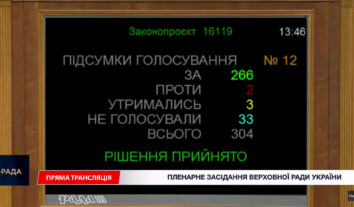
On September 23, 2024, the law “On the Protection of the Constitutional Order in the Sphere of Activity of Religious Organisations” entered into force in Ukraine. It bans the activities of religious organisations that are affiliated with or exhibit signs of ties to the Russian Orthodox Church (Moscow Patriarchate).
On August 27, the State Service of Ukraine for Ethnopolitics and Freedom of Conscience officially recognised the Kyiv Metropolis of the Ukrainian Orthodox Church (Moscow Patriarchate) as being affiliated with the Russian Orthodox Church. On September 2, Yelenskyi announced that the service had filed a lawsuit against the Kyiv Metropolis of the Ukrainian Orthodox Church (Moscow Patriarchate). If the court grants the lawsuit, the Kyiv Metropolis will be stripped of its legal entity status and lose its legal capacity.
Stay connected with us via X, BlueSky, and LinkedIn – and while you’re here, please spare five minutes to fill out our survey and tell us what you’d like to see next.