In Kharkiv Oblast, 12 settlements came under attack within a day: one person killed and another injured
Russian forces launched strikes on 12 settlements in the Kharkiv region on October 17. Oleh Syniehubov, head of the Kharkiv Oblast Military Administration, reported that Russian shelling hit the village of Zelenyi Hai in the Velykyi Burluk hromada – a local government area that includes one or more nearby settlements. Russians killed a 58-year-old man and wounded an 83-year-old woman.
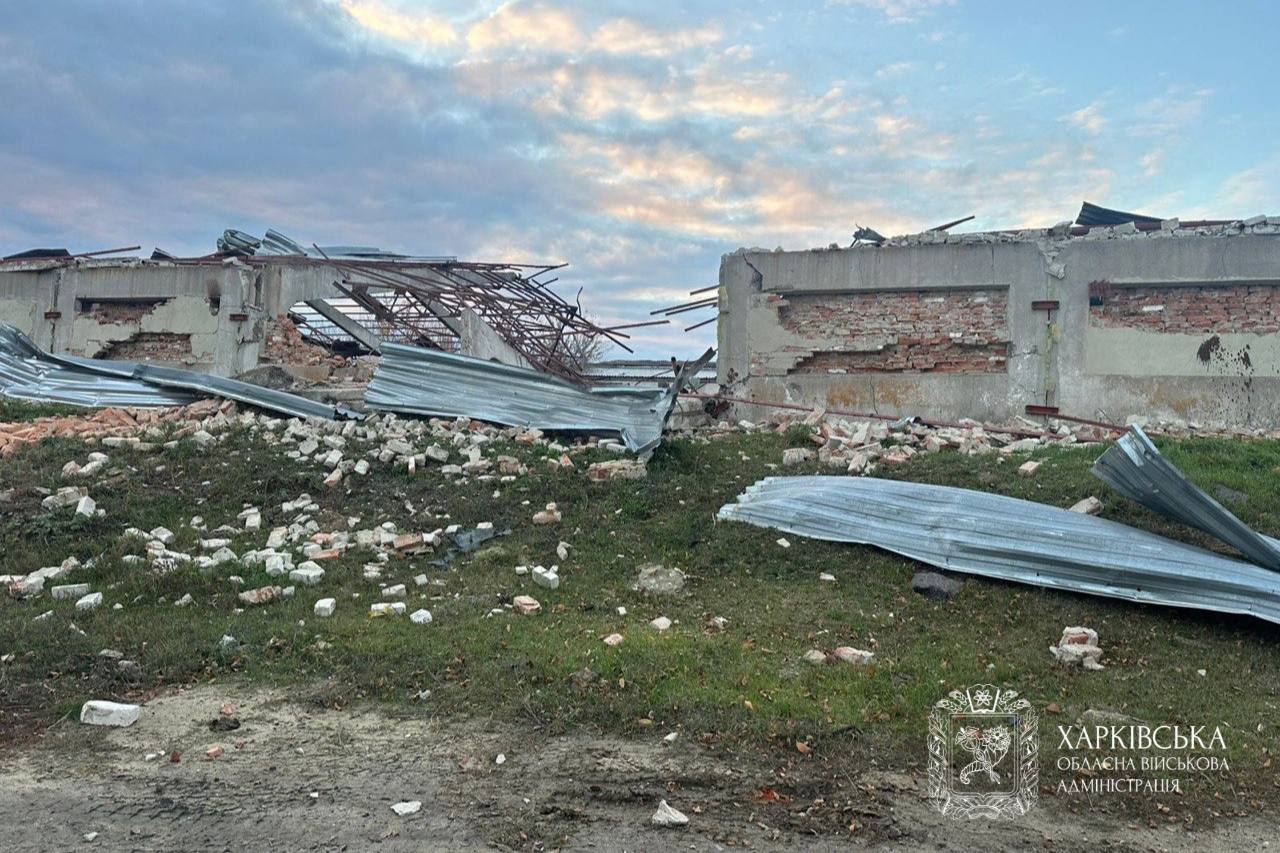
A number of civilian infrastructure objects were damaged and destroyed in the attacks.
“In the Kupianskyi District, 4 private houses, a workshop, 2 tractors, and a car were damaged (Zelenyi Hai village); a civilian enterprise and power lines (Velykyi Burluk settlement); and power lines and a culture center (Shevchenkove settlement). In the Iziumskyi District, a tractor was damaged (Oskil village). In the Chuhuivskyi District, railway infrastructure and a non-residential building were damaged (Chuhuiv city); as well as a private house, a garage, and a utility building (Petropavlivka village). In the Kharkivskyi District, 2 warehouses were damaged (Derhachi city),” the official wrote.
He added that the transit evacuation point in Lozova received 183 people within a day, and another 68 people remain at the point. Since the start of operations, 8,082 evacuees have been registered here.
By way of background, on October 16, Russian forces wounded 14 civilians in Sumy, Donetsk, and Kherson regions. In the Donetsk region, six people were injured, in the Sumy region, five people were wounded, and in the Kherson region, three injured.
Earlier, Bohdan Bernatskyy, a member of the Sanctions Policy Working Group of the Crimean Platform Expert Network, revealed at the Third Parliamentary Summit in Latvia that over 1,300 Russian military companies and 2 million industrial workers continue to operate, many without international restrictions.
Ukraine urges the international community to unite to restore global security under the UN Charter and strengthen sanctions against Russia to enforce compliance with international law. Following Russia’s initial invasion in 2014, Ukraine has pursued the liberation of its territories within its internationally recognized 1991 borders while developing comprehensive reintegration strategies and policies for all liberated areas.
As is known, India, China, North Korea, and Brazil also assist Moscow in killing citizens of Ukraine in Russia’s war, including funding the Russian budget through trade.
To other relevant war news: After the meeting, U.S. President Donald Trump took to social media to call for Kyiv and Moscow to “stop where they are” and end the war. The Trump-Zelensky meeting on October 17 took place a day after Trump spoke with ruler President Vladimir Putin by phone and agreed to meet him in Hungary soon.
Later, a HuffPost reporter asked the White House press team a question regarding a proposed meeting with Vladimir Putin in Budapest. The query was prompted by the city’s history as the site of the 1994 Budapest Memorandum, in which Ukraine ceded its nuclear weapons in exchange for security assurances, including from Russia. The reporter contacted the team to ask, “Who picked Budapest?” White House Press Secretary Karoline Leavitt responded minutes later with: “Your mom did,” and Communications Director Steven Cheung wrote: “Your mom.”
Ukrainian President Volodymyr Zelenskyy stated at a press briefing at the White House that Ukraine needs security guarantees from the United States because, currently, “only President Trump has a dialogue with Russia.” He noted that on the European side, the security guarantees are “almost on paper”, but Ukraine needs security guarantees from the United States.
BBC News reported that after the meeting, Zelenskyy was asked by a reporter outside the White House if he thought Putin wanted a deal or was just buying time with the planned meeting with Trump in Budapest.
“I don’t know,” he said, adding that the prospect of Ukraine having Tomahawks had caused Russia to be “afraid because it is a strong weapon”.
Volodymyr Zelenskyy has said in an interview with NBC News that during his meeting with Donald Trump, the American leader did not say “no” to the possibility of supplying Ukraine with long-range Tomahawk missiles, but did not say “yes” either.
Zelenskyy said he hopes to continue the dialogue on the supply of long-range missiles.
“We use thousands of long-range drones of Ukrainian production on military targets. But Russia uses not only drones of Iranian production and also of their [domestic] production […], but also they use their long-range missiles of Russian production and of North Korea production. It is very difficult just to operate with only Ukrainian drones. We need long-range Tomahawks, and the United States has similar things that we need for a mixed use [combined attacks] like Russia [does],” the President justified.
Meanwhile, the head of the Main Intelligence Directorate of Ukraine, Kyrylo Budanov, addressed the ongoing conflict and its implications for Europe. He stated that the primary threat to Europe originates from the East.
Budanov also noted that by looking at a map where events are marked daily, it becomes very easy to understand what is happening. He explained that all these events, albeit in a slightly different form, were already seen at the end of 2013 and in 2014 in Ukraine.
“At that time, there were no drones, but there were other forms, and everything else is present. This includes sabotage, subversive actions, as well as anti-national or anti-nationalist actions, pro-Russian calls claiming that the leadership is going in the wrong direction,” Budanov said, highlighting that this is a repetition of what has already been practiced and worked very well.
In addition, Budanov emphasized that any military alliance or union formed without Ukraine’s inclusion would be “stillborn,” ineffective, and ultimately fail. He attributed this to both geographical and purely military reasons, asserting that such an alliance simply wouldn’t work without Ukraine.
Spanish newspaper El País reported that the European Union considers Putin’s presence on the soil of the EU an insult. The planned Trump-Putin meeting in Budapest puts the heads of the EU and NATO institutions “in an awkward and unpleasant position,” as Putin and Trump intend to discuss the Russia-Ukraine war in an EU country, but without the EU’s participation.
In public statements, EU leaders say that a Trump-Putin meeting would be beneficial if it helped to end Russia’s invasion of Ukraine. However, in private conversations, several sources have described it as a “political nightmare” for the EU.