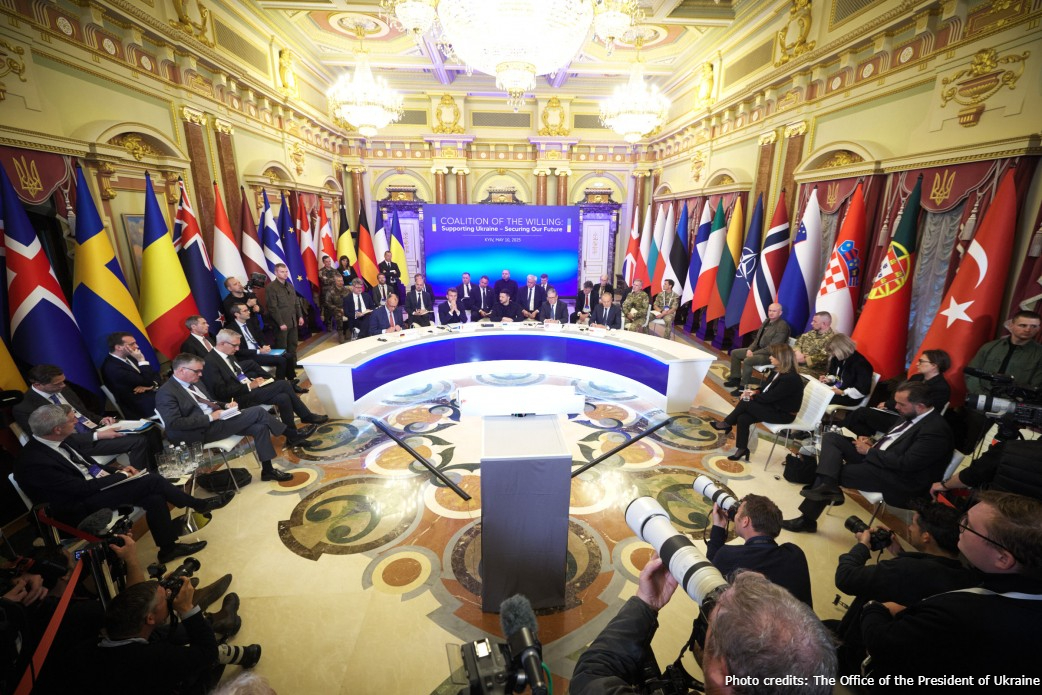
President Volodymyr Zelenskyy published a joint statement by the leaders of France, Germany, Poland, the United Kingdom, and Ukraine following a meeting in Kyiv on May 10, 2025.
The statement calls for a full and unconditional ceasefire for at least 30 days, and the imposition of sanctions against the Russian Federation’s banking and energy sectors should it refuse the truce.
On May 10, Kremlin spokesman Dmitry Peskov, in an interview with ABC, stated that Russian ruler Vladimir Putin has rejected the possibility of a 30-day ceasefire unless the West halts its weapon supplies to Ukraine. Previously, Zelensky explained to Russians the meaning of the word “unconditional,” referring to a 30-day ceasefire.
ZMINA publishes a full text of the joint Statement by the Leaders of France, Germany, Poland, the United Kingdom, and Ukraine following the Meeting in the Ukrainian capital.
On Saturday, May 10, 2025, the leaders of France, Germany, Poland, the United Kingdom and Ukraine met in Kyiv.
They agreed to a full and unconditional ceasefire for at least 30 days starting Monday, May 12, 2025.
They concurred that an unconditional ceasefire by definition cannot be subject to any conditions. If Russia calls for such conditions, this can only be considered an effort to prolong the war and undermine diplomacy.
They demanded that the ceasefire must be comprehensive – in the air, at sea, and on land.
They underlined that it requires effective monitoring, which could be successfully implemented in close coordination with the United States.
They agreed that the ceasefire should last for at least 30 days to create room for diplomacy. During this period, diplomatic work should focus on outlining the security, political and humanitarian foundations of peace.
They welcomed that the call for a ceasefire and meaningful negotiations is supported by both Europe and the United States.
They underlined the crucial importance of strengthening Ukraine’s Defence and Security Forces as the primary guarantee of Ukraine’s sovereignty and security. A key element of security guarantees to Ukraine should also be a reassurance force.
They agreed that if Russia refuses a full and unconditional ceasefire, stronger sanctions should be applied to its banking and energy sectors, targeting fossil fuels, oil and the shadow fleet.
They agreed to pass a strong 17th EU sanctions package and coordinate it with sanctions imposed by the United Kingdom, Norway, and the United States.
They agreed to continue working on the effective use of frozen Russian assets and to discuss this at the next G7 summit.
They expressed their readiness to further strengthen Ukraine’s defence, especially the Ukrainian army. This should include funding defence resilience and investment in arms production in both Ukraine and in European countries in the framework of joint projects.
A day earlier, the Ministry of Foreign Affairs of Ukraine
invited several heads of diplomatic missions accredited in Ukraine, whose high-ranking state officials were present at the military parade in Moscow.
According to the
MFA’s statement, a
demarche was delivered to the diplomats of the respective countries.
The First Deputy Minister of Foreign Affairs of Ukraine
Sergiy Kyslytsya emphasized that, during
Russia’s ongoing war of aggression,
mass killings of Ukrainians, strikes on civilian infrastructure, war crimes and crimes against humanity, the presence of foreign high-rank officials at a parade hosted by the aggressor state is regarded by Ukraine as an unfriendly step.
Ukraine urges the international community to unite to restore global security under the UN Charter and strengthen
sanctions against Russia to enforce compliance with international law. Following Russia’s initial invasion in 2014, Ukraine has pursued the liberation of its territories within its internationally recognised 1991 borders while developing comprehensive
reintegration strategies and policies for all liberated areas.
Previously,
Bohdan Bernatskyy, a member of the Sanctions Policy Working Group of the Crimean Platform Expert Network,
revealed at the Third Parliamentary Summit in Latvia that over 1,300 Russian military companies and 2 million industrial workers continue to operate, many without international restrictions.