From Venezuela to Ukraine, behind every repressed person stands a woman who becomes their voice
“Solidarity may not always open prison doors physically, but it weakens the psychological walls of authoritarianism,” said Tamara Sujú Roa, a Venezuelan criminal lawyer and human rights specialist. “A person who knows they are not alone resists longer.”
Sujú Roa, who mentors Kremlin prisoner Iryna Horobtsova, addressed the Third International Conference Crimea Global during a panel on women fighting violence and oppression worldwide. She spoke alongside activists from the Democratic Republic of Congo, Kyrgyzstan, and Ukraine.
ZMINA has recorded her speech during the conference.
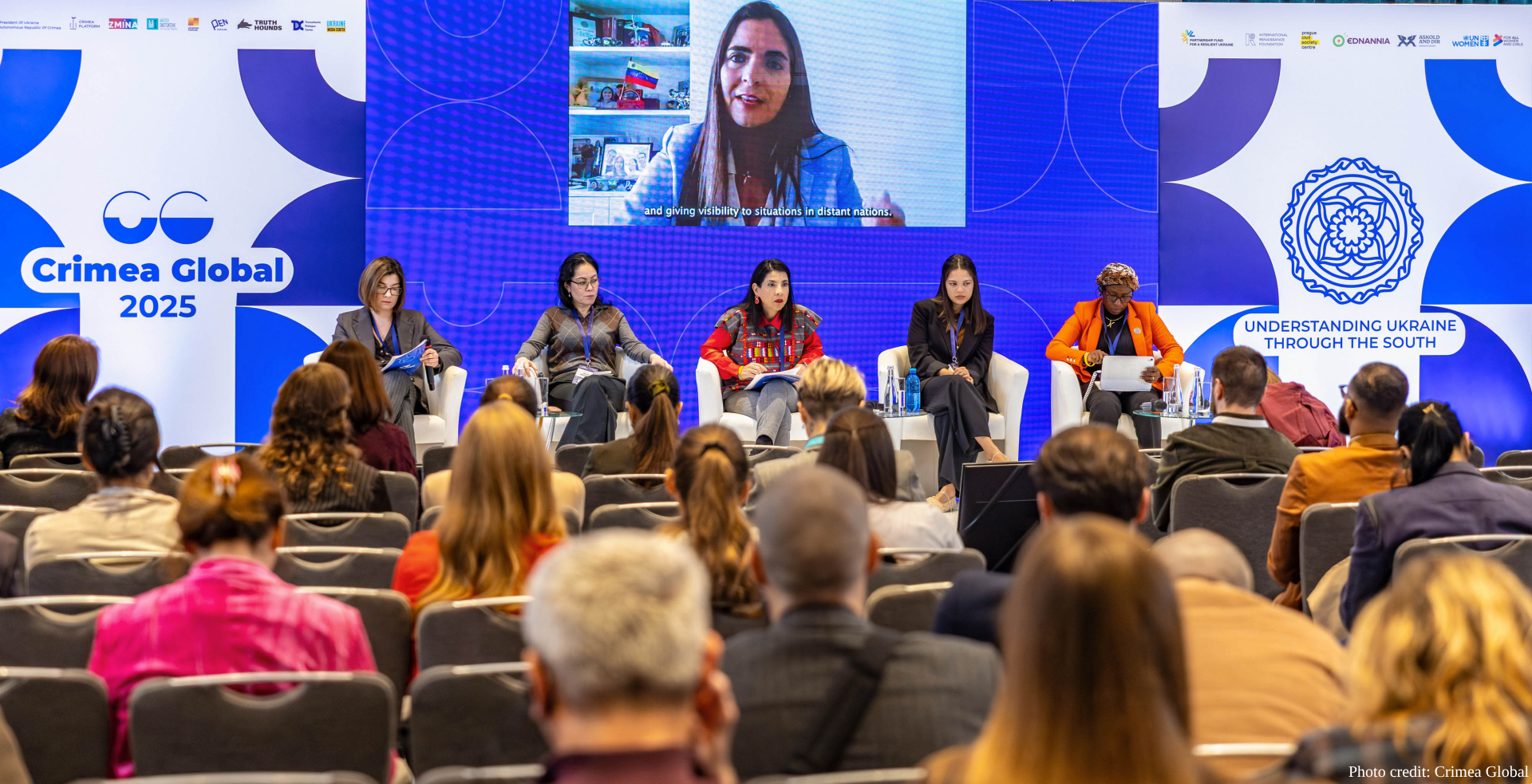
Today, I want to speak about something that transcends borders, ideologies, and geography: How women, especially in authoritarian contexts, can support keeping human dignity alive and lifting each other up.
When we think of modern authoritarian regimes, we usually see numbers: political prisoners, silenced journalists, forced exiles. But behind every number there is a face, and behind that face, almost always, there is a woman sustaining life: the mother who stands by, the sister who denounces, the wife who persists, the daughter who inherits the memory.
Repression tries to generate fear, isolation, and silence. But women — who have historically learned to resist from within the intimacy of the home and the community — continue to weave networks even amid darkness.
Networks of Resistance
In modern authoritarian regimes, women develop forms of support that transcend censorship.
We accompany each other by sharing information, caring for the families of the persecuted, spreading testimonies, and providing emotional support to those facing repression.
These networks are born in the most everyday spaces: the kitchen, the market line, the digital groups where people speak in code. The woman becomes a bridge: she transmits knowledge, protects memory, and makes visible what the regime wants to hide.
Thus, by supporting one another, women not only survive authoritarianism — they challenge it every single day.
Global Solidarity
But women can and must also learn to support each other from distant points beyond authoritarian countries. How?
By creating networks of communication and solidarity, by building communication networks and solidarity tools, by attending and organizing events and conferences about realities in authoritarian countries, by helping reproduce news, and by giving visibility to situations in distant nations. By building community in exile and providing mutual support, by protecting and bringing visibility to situations of repression and to political prisoners around the world.
The Venezuelan woman is a clear example. She has to multiply herself to feed her family, protect her children, and sometimes make the painful decision to separate from them to ensure their future. When a loved one is imprisoned for thinking differently, the woman becomes a spokesperson, a defender, an improvised journalist, a guardian of the truth. In the face of injustice, the Venezuelan woman does not give up: She organizes, denounces, remembers, insists.
Sponsor a Political Prisoner
Let me give you a tangible example of this. The campaign I lead from the CASLA Institute, “Sponsor a Political Prisoner of the World.” This initiative is born from a deeply human principle: one face, one case, one country’s situation.
Giving a voice through a public figure to a political prisoner somewhere in the world. If I name them, they cannot disappear them. If I accompany them, they cannot break them. To sponsor means to take on their name as one’s own, write them letters, accompany their family, denounce their situation on social media, and remind those in power that this life matters — that this person is not alone and a community is watching and sustaining them.
Solidarity may not always open prison doors physically, but it weakens the psychological walls of authoritarianism, and a person who knows they are not alone resists longer.
In this struggle for freedom and dignity, I want to extend my embrace to the people of Ukraine — a people who today defend not only their territory but also their right to exist and to decide. To Ukrainian women — mothers, volunteers, nurses, defenders, women who send their children to safety while they stay to protect their nation. We say: you are not alone. From Latin America, from Venezuela, from every country where freedom has been wounded, we recognize your courage. Your resistance inspires us. Your pain calls us, and your hope is also ours.
Because when one nation defends its freedom, it defends the freedom of all.
Freedom does not always begin with a great revolution. Sometimes it begins with a simple human gesture: Telling someone we will not leave them alone — that small act, repeated thousands of times, can change the world.
Stay connected via X and LinkedIn with ZMINA – and help build this platform with us by filling out our anonymous 5-minute survey here.