Why “good Russians” in exile repeat Russian and Soviet colonial narratives
Russian opposition figures in exile say they want democracy, human rights, a free Russia. But when Yulia Navalnaya dismisses decolonization activists as “decolonizers,” when exiled politicians insist that Central Asian nations would be unable to function independently without Moscow’s control — they are not advocating for freedom. They are advocating for regime change while preserving the empire. This narrative — that Russia brought civilization to “backward” peoples — did not end with the Soviet Union. It just modernized, argues Leila Seiitbek, a Kyrgyz human rights lawyer now in exile in Vienna, where she leads Freedom for Eurasia, an NGO exposing corruption and human rights abuses across Eastern Europe and Central Asia.
Speaking at the Third International Conference Crimea Global about how former colonies can shed imperial perceptions, Seiitbek challenged audiences to recognize that even liberal Russian opposition leaders continue carrying forward Soviet-era propaganda.
ZMINA has recorded her speech at the conference.
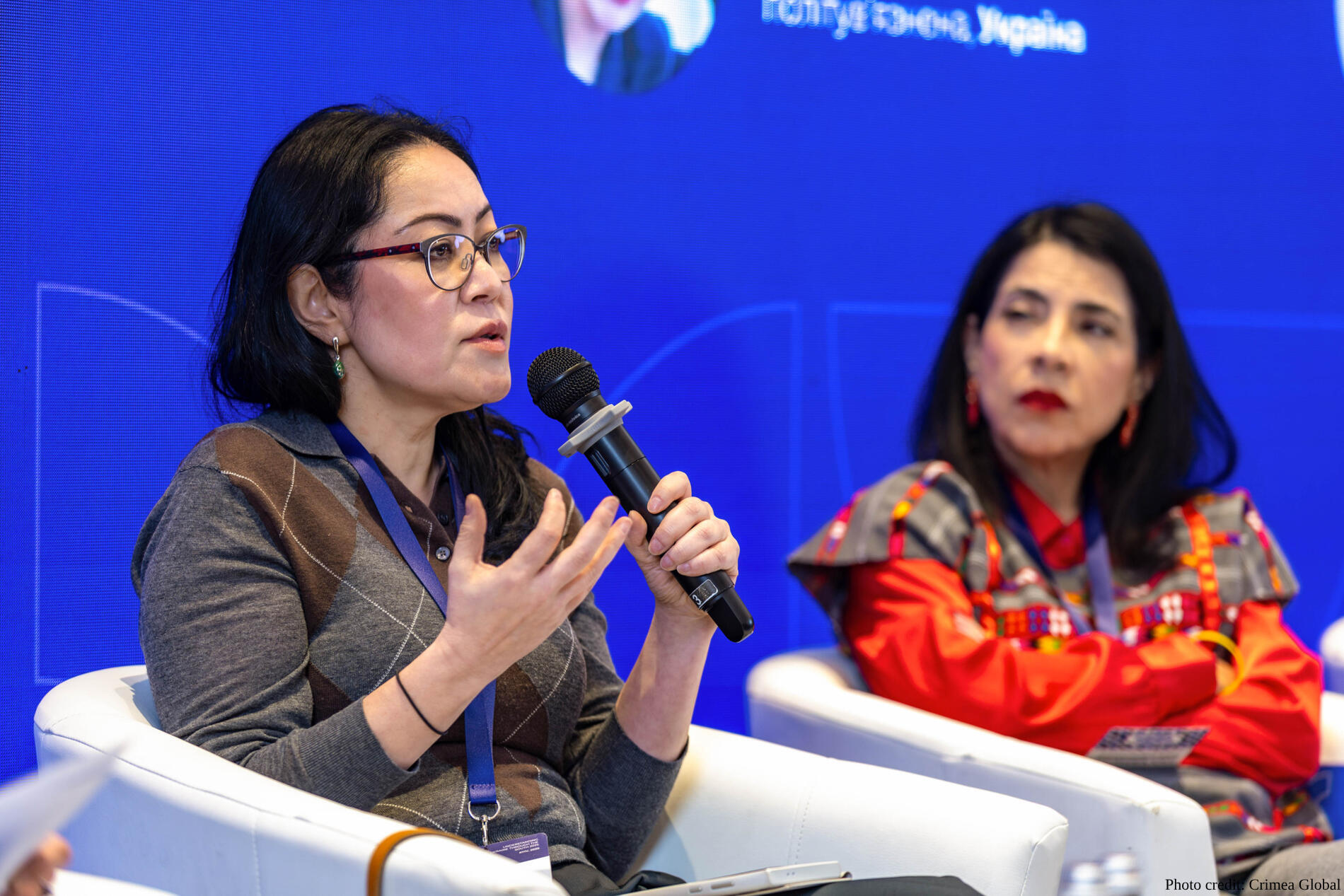 Leila Seiitbek
Colonial Legacy and Lingering Influence
Russian colonization has shaped Central Asia profoundly. The region was colonized first by the Russian Empire, then by the Soviet Union, and remains under significant Russian influence even now. Russia’s grip on the region is not weakening.
The process of decolonization in Kyrgyzstan has begun, though it remains limited. For now, it means giving people the ability to express themselves in very small ways, because the situation in Central Asia is such that people are surviving under authoritarian rule. At present, none of the countries in Central Asia can be described as fully democratic.
In our experience of colonization by Russia, many things are very similar to what Ukraine has experienced and what Crimean Tatars have experienced.
First and foremost, decolonization is a process that includes the right to use your own language.
In Kyrgyzstan, that is exactly what happened to us. After Russia took control over our territories, it denied us the right to use our own language. I, as a Kyrgyz person, grew up speaking Russian, and unfortunately, I still speak Russian much better than Kyrgyz. I started learning my own native language only as an adult — only after the collapse of the USSR.
This is quite sad, because to us as nomads, language carries such utmost importance. As nomads, we did not build temples or palaces. Our temples and our palaces were our language — and it was taken away from us for centuries. We were not able to use it.
During colonization, we were separated from our historical memory by several changes of alphabet, which increased the distance between us and our ancestors’ knowledge — a distance that was just impossible to reverse. We cannot go back and read whatever they left for us to read.
We were not allowed to be Kyrgyz. We were not allowed to practice our traditions in a free way. We were not allowed to speak Kyrgyz in public places. If it was ever spoken, it was spoken very quietly, somewhere in the kitchens.
That narrative needs to be challenged and dismantled. That should also lead to some sort of independence in policymaking of the governments in our region. However, it’s still too early to talk about them being able to make their own decisions without looking at the Kremlin and seeking validation.
The colonization of Central Asia has been presented to us — the indigenous nations — as a great gift. Russian people brought us factories, schools, and libraries, they told us. What they fail to mention is that in the territory Russia claimed as its own, there were other civilizations existing at that time — and states that were demolished, their resources were partitioned and exploited by the Russian Empire and later the Soviet Union for its own purposes.
This narrative — that Russia granted us the great gift of modernization, and otherwise we would have been left backward, illiterate, stupid barbarians — has not changed to this day. Moreover, it has modernized.
“Good Russians” in Exile: The Same Old Story
Even now, the Russian opposition in exile continues to carry this narrative forward and to deny agency to the nations that remain under Russian control.
For example, Yulia Navalnayaі made a post on X that caused a significant stir, especially in decolonial circles, where she spoke very negatively about the decolonial efforts of various activists. She called us “decolonizers”.
Russian politicians who have been rescued from Russia and finally gained access to various platforms to speak also quite often use these platforms to say that the nations held captive within Russia are unable — will be unable — to function as separate sovereign states, and that the West must do everything possible to ensure that Russia is preserved in its current form where the only difference they envision for that country is one without Putin, or somebody else to replace Putin.
We all understand that by its very nature, Russia is not a country that can be democratized. It was not built that way. Its foundation, its structure, and the essence of its existence — the very reason for its existence — is anti-democratic. It cannot function in any other way.
The only way it can continue functioning is by maintaining its current autocratic rule, whether with Putin or somebody else. It does not make any difference at all. Changing the leader will not make any difference at all.
Unfortunately, these “good Russians” who are traveling the world right now continue carrying forward the same narrative that was used during the Soviet times — the propaganda of this great gift of modernization.
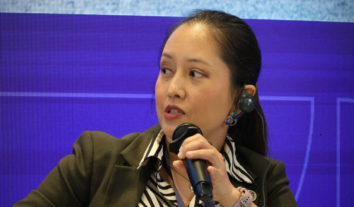
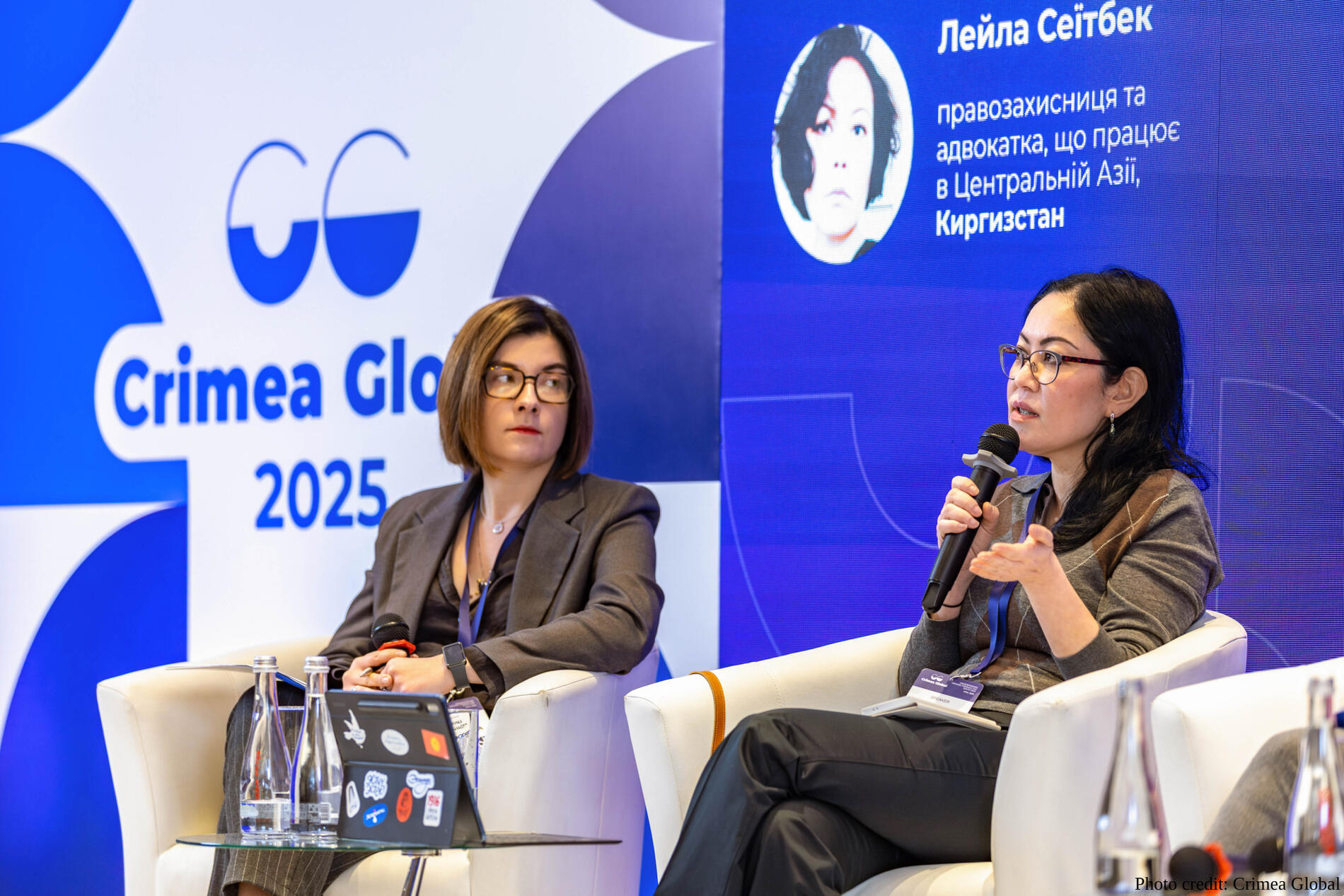 On the photo: Iryna Slavinska and Leila Seiitbek
Decolonization Is a Process, Not an Event
Decolonial activity is really not an action — it is more of a process. It includes many different aspects. It is reimagining. It is reframing and rewriting — in a good sense, reassessing history from the point of view of the colonized nation. Basically, it means having the ability to go back to things that have happened and evaluate them. For us, for example, that means evaluating our history in Central Asia. For Ukraine, that would be Ukrainian history; for the Crimean Tatars, it would be Crimean Tatar history.
This is a really large part of decolonization — just continuing to voice that narrative and continuing to share your views and information in every possible way: in social media, in newspapers, in articles, in interviews. I think it is very important to be able to use any available platform to put that information forward. You might think it’s not important — it is really important […].
Another aspect of decolonial activity would be ensuring that people who are trying to preserve colonial narratives receive adequate responses. The various Russian journalists now working in exile continue to perpetuate Kremlin propaganda, thinking it is very important for them to preserve this image of Russia and to somehow convince the West — convince Europe in particular — that somehow Russia, for example, is part of European civilization.
That was what I read in Yulia Navalnaya’s speech, for example. It is not true. I think it’s very important to be able to challenge these narratives and to come forward when people are trying to preserve and continue these imperial narratives that are not true.
Russia is not part of European civilization. Being a part of European civilization, it is not just a geographical matter — you also have to bring your values with it, and that is a very important aspect as well.
Rethinking your traditions and what you are willing to bring with you into the future is also a very big part of decolonial discourse. What from the past can be carried forward for the next generations? What is important to impart to the coming generations? These are crucial questions. Decolonization is a very multifaceted field that you can apply anywhere, really — in academic work, art, and filmmaking […].
Reconciliation That Never Began
Regarding reconciliation. It’s not a one-time thing. It’s a very long process.
Unfortunately, as I have mentioned, the reconciliation with our colonial past with Russia has not even started. They did not acknowledge, they do not understand, they do not want to talk about it. They are very nervous about us even raising the issue.
I know for sure that scholars researching the issue of decolonization in Kyrgyzstan face significant obstacles. I do not conduct in-depth academic research on this — it is not my primary area of focus. Others do deeper work and face many problems with the Russian FSB in Kyrgyzstan. They are under surveillance and are controlled through digital means and other methods.
Russian authorities really don’t like it. I think the ongoing effort will take quite a while before anyone can say the reconciliation process has begun or reached a point where people can speak freely.
But again, reconciliation doesn’t mean you reconcile and then let the colonizer be. It’s an ongoing process of accountability and truth-telling.
Leila Seiitbek, human rights activist and lawyer working in Central Asia, Kyrgyzstan