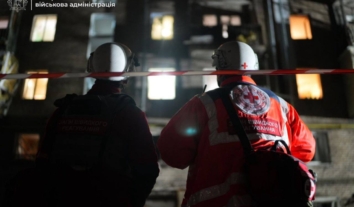
Prison guards at “Izolyatsia” replicated torture methods shown in the American film The Mauritanian: Daniil Bulhakov says after three years in “DPR” prisons
Daniil Bulhakov, a resident of Donetsk, was detained by the Russian occupiers in August 2020. The 22-year-old student was accused of “spying for Ukraine” and illegally held for three years in various detention facilities, without trial or investigation. As a result of prolonged torture, Bulhakov’s physical condition deteriorated severely. His asthma worsened, and he also suffered serious psychological and emotional trauma. Today, he lives in the Kyiv region, where this interview takes place, and is trying to forget all the horrors he experienced in captivity.
The so-called “DPR”і forces unlawfully held Daniil for seven months in a torture facility known as “Izolyatsia”. He was later transferred to Makiivka Penal Colony No. 97, where he spent more than two additional years.
In an interview with ZMINA, Daniil Bulhakov described how people in the “DPR” were imprisoned just so their property and businesses could be seized, how things changed in prisons when the Russians took over, how he met British prisoners Aiden Aslin and Shaun Pinner at the colony — where they were facing the death penalty, and how the guards of “Izolyatsia” borrowed ideas for torture from the film “The Mauritanian.”
Daniil, could you please tell us where you were abducted and what preceded it?
I was born in Makiivka. I lived most of my life in Donetsk, where I had an apartment in the city centre. At that time, I was studying computer programming at the Donetsk Electrometallurgical Technical College. Realising that I would not have a normal future under occupation, I moved to Kharkiv in 2016, where I enrolled in the Faculty of Aerospace Engineering. But in 2019, I was forced to return because my grandmother was diagnosed with cancer. At that time, in order not to waste a year or two, I enrolled in the Department of Radiophysics at Donetsk National University. However, I never graduated.
In May 2020, my grandmother passed away. So I began preparing the inheritance paperwork to keep my parentsʼ flat, which she had previously taken care of. Even then, I was thinking of returning to Kharkiv before the borders closed due to coronavirus restrictions. “I really know how to choose the ‘right’ moment,” he says with a sad smile.
On August 19, 2020, as I was about to leave the house to submit paperwork related to the apartment, the intercom rang. I remember clearly that it was 10 a.m. because I looked at my watch at that moment.
When I answered, a man on the intercom told me they were conducting a police patrol, so I had to open the door to the building entrance, which I did. I could hear that they were not going into the flats on the first floor, but were going straight to the second floor, where I live. They knocked on my door. Two men in plain clothes showed me their MGB IDsі through the peephole and ordered me to open the door. I couldnʼt see anything, but I decided to let them in because I thought something might have happened to my friends.
I did not even manage to open the door before it was forced open, and two or three uniformed men burst into the flat. It was clear they had been hiding in the stairwell so that I would not see them. They immediately threw me to the floor, put a bag over my head, and bound my hands with duct tape. They also wrapped tape around the bag on my head, though not tightly. They did not even remove the rucksack from my back, but dragged me downstairs with it still on me.
I had difficulty breathing due to bronchial asthma.
“I believe they were after my Stalin-era flat in the city centre.”
Did you have any medication with you? Have you suffered from asthma since childhood?
Yes, I had an inhaler. At the age of 4, I had an allergy to ragweed, which then triggered bronchial asthma. I also have allergies to dust, animals, etc. After my captivity, the disease worsened, so now I use an inhaler every 2–3 days.
Did they say anything during this?
They were shouting and swearing, but I was in such shock that I couldnʼt hear them.
My neighbours later told me that I was taken out of the building and forced into a white BMW with no license plates. Two occupiers sat next to me, and two more sat in front.
We arrived at a building on Shevchenko Street, which had housed the state tax inspectorate before the occupation. They pulled me out of the car and took me to a room on the first floor. The room was covered in plastic. They sat me on a chair in front of a table and removed the bag from my head. My hands, tied with tape, were numb.
Two operatives sat in front of me and showed me their IDs. They started saying that I worked for the Security Service of Ukraine (SSU) and provided them with some information. I denied everything. I tried to explain that I was a student, that my grandmother had died, and I was processing the inheritance documents. The occupiers ordered me to tell them everything about myself, starting with my childhood. While I was speaking, another man came in to ask them something. Then they interrupted me and demanded that I start all over again. This happened several times.
I felt like the interrogation lasted three hours, but it turned out that I had been there all day. At the end, they gave me blank sheets of paper to sign, but I refused.
Was force used against you on that day?
That day, they behaved politely, only slapping me on the back of the head and punching me in the stomach a few times. They were very triggered by the word “just” (in Russian “prosto”). Since then, I do not like it myself either.
After the interrogation, they left me in the same room and handcuffed my hands to the radiator. I asked to be taken to the toilet, but they did not let me. They did not give me a bottle either. There was only a table and two chairs in the room.
I asked for water, but they did not give me any, saying, “It is not allowed”.
Daniil, how long were you kept like that?
In the morning, they came with their favourite “friend” – the “tapik,” a communication device that delivers low-voltage electric shocks. They chained me to a chair. Once again, they asked whether I wanted to sign. When I refused, they placed clamps between my fingers and began administering electric shocks. Then they tried to tape them to my neck. They also attached them to my nipples and groin.
Itʼs hard for me to describe the feeling. I felt completely numb. I lost consciousness twice. When I came to, I saw they had changed my position, and the clamps were in different places. They electrocuted me until almost evening. Again, they told me to tell them about myself, starting from my childhood.
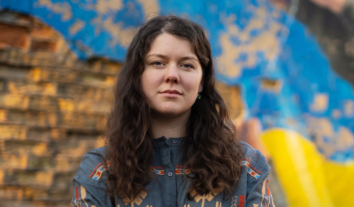
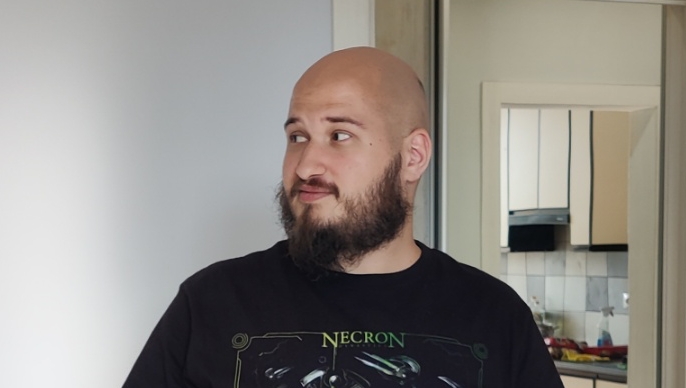 Daniil Bulhakov. Photo credit: ZMINA
Sometimes they went out for a smoke and even offered me some.
Were doctors present during the interrogation?
No. I had already started having asthma attacks, which worsened during the torture.
By the evening, I signed the papers they brought again. I thought, to hell with it, this all had to end.
During the torture, they behaved quite calmly, as it was a routine for them. Just this month, I had already been with this “pair”, and there were about five of them, probably ten or eleven. They understood that I would sign anyway.
Did they give you water?
To be honest, in the first few days, and this happens to almost everyone, I didnʼt want to drink, eat or go to the toilet at all. Even when they threw me in the cell, I didnʼt go to the toilet for three days. All this happens against a backdrop of severe stress.
Then you start drinking water so greedily that it makes you sick.
Daniil, after the torture, did they take you back to your cell or leave you there?
They chained me to the radiator again and said that I had done well to sign, because “everything had already been known and understood anyway.”
In the morning, they broke into the room, put a bag over my head, and dragged me to the far end of the corridor. There, they put me in a “lastochka”і in some room. In the middle of the room, they sat me on a chair. I heard voices behind me, so I assumed that the “MGB” leadership was there.
A man came up to me and said: “See, Dania, how important you are? I came from Moscow for you. The SSU received 8,000 dollars for you”. I sat there thinking: “Wow, I must be quite expensive”.
He had good diction, was polite, and gave the impression of being quite intelligent. It created a false sense that you could trust this person. You sit there, and gradually you develop Stockholm syndrome. Even though you realise that nothing like that actually exists.
Then he says: “Now you will tell the people behind you how you spied. We will listen to you. But if anything happens, you will be to blame, so tell only the truth“.
They reconnected the clamps to my legs and arms and began to interrogate me. The people sitting behind me asked questions. I said that I hadnʼt done anything, so I didnʼt know anything. When they didnʼt like my answers. They electrocuted me.
The people sitting behind me said that was enough for today. However, the man from Moscow suggested conducting another “procedure” as a preventive measure. For some reason, they like the word “prevention.”
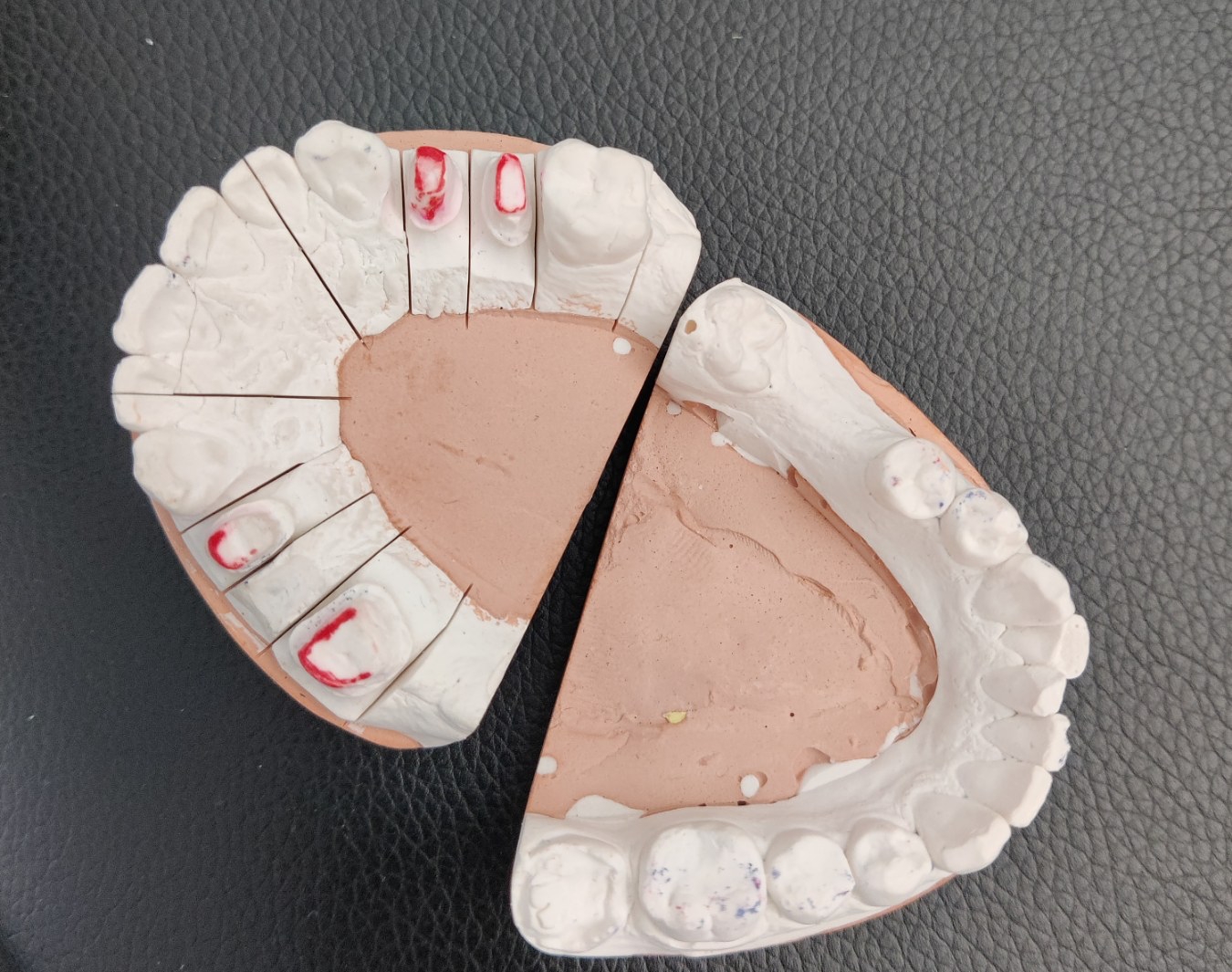 A cast of the filed-down teeth. Photo credit: ZMINA
They put some kind of spreader in my mouth. I never understood what it was made of. They tilted my head back, pulled my cheek to the side, and he filed down two of my teeth to stumps with a needle file [a small file designed for very fine and precise work. – Ed.]. I lost consciousness about ten times.
All this time, I sat with a bag over my head so I couldnʼt see the people in the room. From their voices, I realised there were about ten people there.
I recognised my investigators by their legs – the same operatives who, over those days, had become “like family” to me.
Did they do similar cruel things to others?
No, but every time he “worked” with someone, he would give them a “surprise” from himself. I found this out later when I talked to the other guys.
After the “procedure”, the torturer brought me a small piece of plum cake to mock me. He knew that after having my teeth filed down, I couldnʼt eat sweets.
Can you please tell us what exactly they asked you during the interrogation?
They asked when I started communicating with the SSU, when the SSU contacted me, what I told them about the strategic objects of the “DPR”, who I recruited from the locals, what weapons we were transporting, where we were hiding them, and so on.
I had to confirm that I had been in contact with the SSU. I had no choice but to incriminate myself. Only when they asked if my friends had weapons did I answer that they did not.
I got the impression that they didnʼt care at all. They extracted a confession and then relied on it without involving any witnesses.
I believe they were after my 200-square-metre apartment in the city centre. Itʼs a very nice area with convenient transport links.
Did you see the room where you were interrogated this time?
I was in it later when they took me to the investigator for interrogation. It was a fairly large room with an old, Soviet-era long table and office chairs. It was located on the first floor, and the MGB used it for torture. They called it the “torture chamber”. Everything in it was equipped for that purpose. Their leadership was located on the upper floors.
After such brutal torture, did they at least take you to a doctor?
After all that, they took me to a polygraph test, which I slept through. I heard in the background that the polygraph examiner was swearing at the operatives: “Why did you bring him here in this condition? He canʼt say anything“.
How long did it all last?
They finished around 8 p.m. After the polygraph, they took me to the doctor because they had to deal with my asthma so that I wouldnʼt just die there. The doctor said that if anything happened, I should use my inhaler.
I lied to them and said I had a heart defect. I decided to save myself from the “tapik”. I think they would have electrocuted me for two more days, just like the others. The doctor didnʼt examine me; he just asked what kind of defect I had – upper or lower. I said lower.
Why do you think a doctor was needed if he didnʼt help in any way?
To register me. When you are sent to a pre-trial detention centre or a prison colony, you must be examined by a doctor who records the condition you were in when you arrived. In short, his stamp must be on the paper. He wrote that I was completely healthy.
In Donetsk, they called it “administrative arrest”. The FSBʼs discharge papers donʼt even mention the month when I was detained.
Then they stripped me naked and photographed my tattoos on my arms and back (a rose, ed.). They said they sent these nude photos to my girlfriend. Later, when I talked to other prisoners, they told me that their naked photos were sent to their relatives. Like, look who youʼre hanging out with. They could write that heʼs gay. I am bisexual, in fact. When they found relevant hints on my phone, they said that I was done for and that they would beat me up right then and there. They threatened to tattoo the word “stoker” on my buttocks, alluding to prison “bottom boys”. At first, it was even scary.
The “operatives” took my photos with my swollen face and said they needed to be photoshopped. Part of my face was numb and felt cotton-like.
Then they put me in a car and took me home. It was 9 or 10 oʼclock in the evening. They entered the flat to take the computers and all the valuables that were there. They took my phones, hard drive, computer and backpack for the investigation.
In the backpack was my fatherʼs gold ring, which they later returned.
After all these procedures, they took me to Izolyatsia, where I was held with Stanislav Asieievʼs cellmates. Everyone there remembered him.
When they brought me in, the guards who were with me handed a piece of paper to the new guards. But I have no idea what was written on it. There were two shifts at Izolyatsia – “good” and “bad”. I got the “good” one. I remember that one of the guards was called Valter. They didnʼt beat me at the “reception,” they just took off my shoelaces and read me the rules of conduct in the cell. For example, when the guards enter the cell, I have to pull a bag over my head, turn away, and look at the wall. If I donʼt do it in time, they beat everyone. In other words, the Makarenko principleі was applied there to the fullest extent.
What does the “Makarenko principle” mean?
In the Soviet Union, a teacher named Makarenko worked with homeless children. He gathered them and kept them in an educational institution where he practised his methods. One of these methods involved collective responsibility. If one person misbehaved, everyone was punished. Interestingly, Makarenkoʼs book was kept in the cells.
A week before my detention, I was walking near “Izolyatsia” with friends – we were looking for abandoned buildings to play airsoft.
When you were approaching “Izolyatsia”, did you see what it looked like from the outside?
It was an ordinary factory surrounded by a brick fence without barbed wire and a checkpoint at the entrance. A week before my arrest, my friends and I were walking near it because we were looking for abandoned buildings to play airsoft. When we passed by, we thought it was some kind of military unit. Who knew then that I would end up here?
Then the lads who went to work there told us that you could easily leave and go home. In other words, in some places there was no fence. Everyone just understood that if you left, your whole family would be in trouble. And during the coronavirus pandemic, where can you run to when the borders are closed?
How many people were in the cell?
It was a small room in the administration building. Probably 9 metres by 7 or 5. At that moment, there were 15 people there.
The two windows, which had bars on them, were painted over. Bunk beds were attached to the walls – upper and lower ones, with crooked boards lying on them. Behind a waist-high partition was a toilet. There was a sink, but we were given water from a fire hydrant once a day. It could contain worms, reeds, sludge, etc. We collected it in dirty and mouldy bottles.
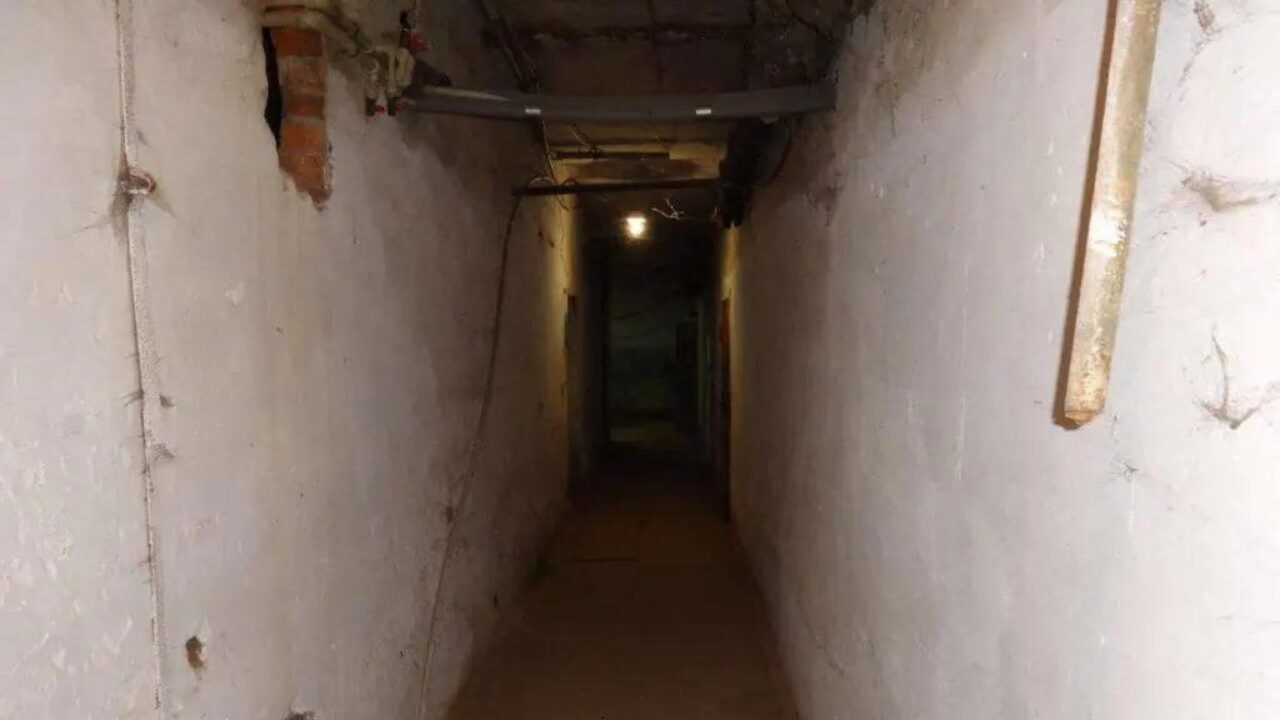 Photo credit: from open sources
There was a video camera in the room, and we had to stay within its field of vision. If they noticed that you were trying to avoid it, they would beat you until you lost any desire to do so. It was the same in the toilet. They had to see everything you did there.
Wake-up was at 6 a.m., and lights-out was at 10 p.m. After wake-up, there was a three-minute outdoor walk. Between the two buildings was a courtyard surrounded by an iron fence and covered with barbed wire. You could smoke there because it was forbidden in the cell. One woman tried to smoke in the cell, and they broke her fingers for it. We decided not to take any chances.
Once a week, we were taken to the shower room, where there was a 30-litre boiler for 100 prisoners. We had 7 minutes for 5 men to wash.
Did you have separate cells for men and women?
Opposite us was womenʼs cell No. 7. There were two other cells where women were held, but I donʼt remember the numbers.
We were all held on the first floor, while the “DPR special operations forces” lived on the second floor. They didnʼt care about us. We were their labour force: we cooked food, fed their pigs, carried mattresses, loaded shells, and repaired military equipment.
What did they give you for breakfast, lunch, and dinner?
25 grams of wheat porridge with stones and two slices of bread. It felt as though they had bought animal feed and cooked it. And so it was three times a day. We had a kettle, but no tea.
What did a typical day in “Izolyatsia” look like overall?
Most people just sat in their cells and waited to be called to the investigator.
We were allowed to read Soviet literature. For example, I read The History of the Russian Empire, The History of the Second French Revolution, Pikul, Tolkien, Agatha Christie, and American science fiction. Most of these were books that the prisoners had brought with them. I managed to get hold of Don Quixote and Andre Norton. You could even find strange books there, such as the two-volume Bhagavad Gita and books on Lamaism.
We started playing Mafia. We made little cards out of paper — one marked “mafia” and the other “police”. We had to pass the time somehow.
Who were you in the cell with?
I was with the same people until I was transferred to the colony. We had a Muslim who now lives in Germany. We were held with the director of a soap factory, the head of the “prison special forces of Ukraine”, the head of the “DPR” customs task force, DPR drug addicts, and an old communist. He was a member of the “DPR” Communist Party.
There were “overseers” from the security service in the cell. It was an official position. Four bandits who beat up a Russian FSB officer became the leaders of the cell. As punishment, they were thrown into “Izolyatsia” for six months. That was all they could do to them, because they were protected by some high-ranking figure. No one touched them. Moreover, they were pro-Russian “athletes” who were allowed to beat other prisoners for their pro-Ukrainian views.
Espionage was the most commonly used charge for imprisoning people.
And what about the other Ukrainians who were sitting with you? What were they arrested for?
Almost all of them were accused of espionage. It was the most common charge. From 10 to 20 years without the right to a lawyer, early release, visits from relatives, etc. A very convenient charge.
Some were taken because of their businesses, particularly company directors, while others were taken because of relatives who served in the Armed Forces or lived in the free territory of Ukraine. We were a very diverse group. But for the most part, people were held for financial gain, to obtain ransom or take over a business or apartment.
In October 2020, a large exchange was planned, so they gathered a large number of people throughout August. But because of the coronavirus, the exchange was cancelled, the colonies were closed for self-isolation, and people were stuck there. We spent seven months there. Then there was a slight decline, and we were transferred to the western correctional colony No. 97 in Makiivka.
In October, a Russian with the call sign “Khytryi” (Cunning) arrived and changed everything. There were more surveillance cameras in the cells. They renovated, whitewashed the walls and added bunks, making them three-storey. There were more people in our cell, from 15 to 21.
With the arrival of the Russian, loud conversations were banned and all work was cancelled. And the “Kontiki” stopped coming in as well.
What is “Kontiki”?
In 2015, the Konti confectionery factory tried to transport its products, but the “DPR” took the vehicles and loaded the sweets (Kontiki biscuits, Ferrero Rocher chocolates, and Barni biscuits) into the Izolyatsia hangars.
All these years, the sweets lay in the rain. Their shelf life expired in 2015, so the guards fed them to the pigs they kept in the torture chamber. We also ate them when someone brought them after work. If a kind guard was on duty, you could take a whole bag to your cell.
The most interesting thing is that Muslims were forced to slaughter pigs. Two Jordanians were sitting with me – one was married and had lived in Ukraine for a long time, while the other was just studying here. They were the ones who were bullied the most.
We also had a pro-Russian Israeli citizen, Oleksandr Pereverziev, in our cell. He created the first “DPR” unit. When one of the generals decided to launder money, he was made the scapegoat. He had lived in Russia for many years. He once served in the Russian army in Transnistria. Later, in 2014, together with Borodaiі and others, he brought weapons from Russia to Donbas. And then he created a “unit of retired veterans”, as we called it. When he got out, he went back to his old ways. Itʼs incurable.
After the start of the full-scale invasion, three foreigners were brought to the colony – a Moroccan and two Britons.
Apart from the Israeli and Jordanians, were there any other foreigners?
After the full-scale war began, three foreigners were brought to the Makiivka colony: Moroccan Brahim Saadoun and Britons Aiden Aslin and Shaun Pinner. They were imprisoned with us. They were great guys, especially Aiden. They knew a little Russian, so we could communicate. Plus, a Jordanian who was in our cell could translate. He knew Russian, Ukrainian, English, Arabic and Turkish.
With the arrival of the Russian with the call sign “Khytryi”, who headed the torture chamber, did the attitude towards you change?
They began to beat us regularly for no reason or for not entertaining the guards. We had to sing hymns or songs for them or dance. It became normal to be beaten in the genitals, especially during searches. During cell searches (“shmony”), which under the new leadership took place weekly, all prisoners had to come out one by one and stand in the “star” position. Once, they put me in the splits because I was flexible. I had been doing taekwondo for five years.
Sometimes they electrocuted us. Sometimes they would take us to the basement and choke us there. Sometimes they would beat us on the back or legs with a rubber baton, which left marks that are still visible today. I was beaten with a stun gun several times. It was small, but it hurt. Thatʼs how they entertained themselves.
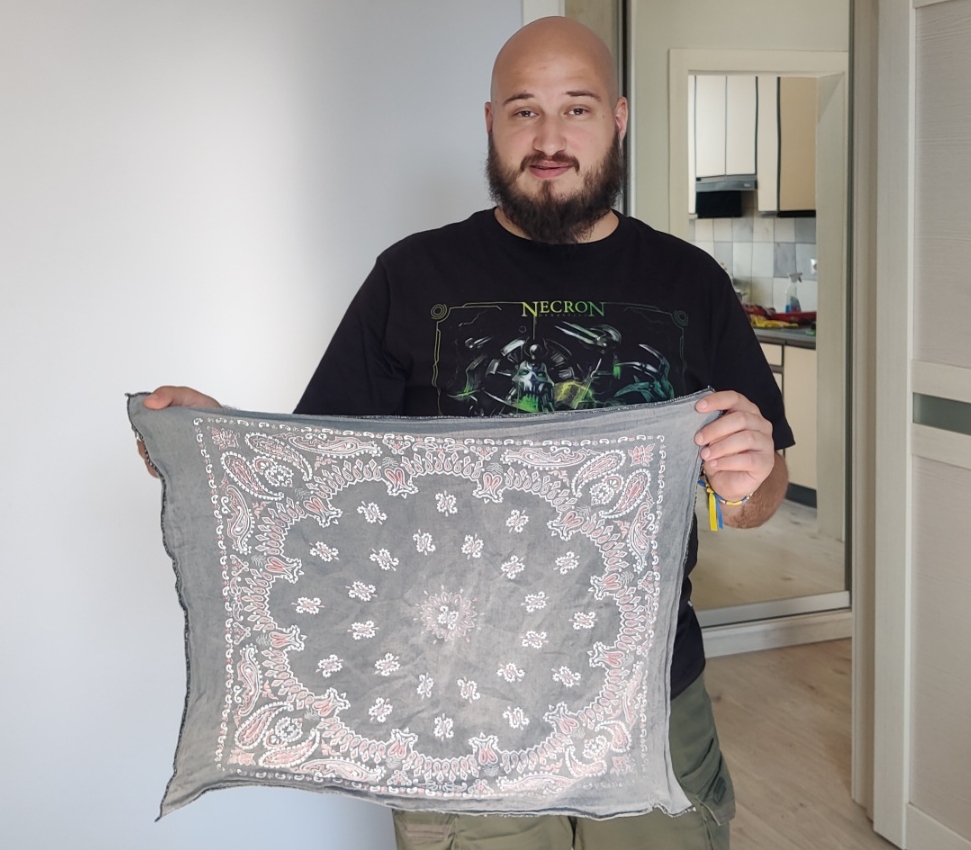 Photo credit: ZMINA
In the cell, they forced everyone to do push-ups together, performing all these exercises and hitting each other with their elbows. They also made us move back and forth in a squatting position. Or they forced us to climb up and down the stairs. Once, we were punished for smoking in the shower by being forced to do 500 squats for two days and hold a pillow at armʼs length for an hour. If anyone lowered their arms, they would be hit on the back with a baton. This “exercise” was called “crossfit”.
They loved watching American films and borrowing ideas from them to torment us. The film The Mauritanian is awesome, but I donʼt like it because the guards liked it. They used the torture techniques from it on almost all the prisoners in Izolyatsia. In particular, they borrowed the [waterboarding] torture technique with a towel and water, where they put a towel over a personʼs face and pour water on top of it so that the person chokes.
They submerge you in water so you canʼt breathe, or lock you in a cell and turn up the speakers under the iron door to maximum volume. Not only can you not sleep; you canʼt even think. This could go on for 24 hours, three days in a row.
Once, they told the men who were imprisoned for espionage to shave their moustaches like Hitlerʼs.
“Khytryi” believed that we should not sit in one place for long, so we had to arrange “contrast showers”. For example, they would punish someone for falling asleep, entering the “blind zone”, behaving badly during interrogation, shouting or arguing. They used to beat us, but not as often and not for everything.
At the same time, they started feeding us better, even giving us cutlets and soup.
Was there conflict-related sexual violence (CRSV)?
It was a constant thing – torture of the genitals and threats of rape.
Someone was always screaming. We could hear everything because there were thin iron doors, which, in my opinion, amplified all the sounds.
The lawyers had a standard practice: they took a thousand dollars from relatives and then told the judge what you could be imprisoned for.
Were you personally taken for interrogation?
A month after my stay in “Izolyatsia”, I was taken to an MGB investigator who was a little older than me. At that time, I was introduced to a lawyer named Valerii Akapian. His favourite joke was: “Dania, I may be Akapianі , but I am not a magician — you will still have to serve your twenty years”.
All local lawyers had a standard principle: they talk to you, take at least a thousand dollars from your relatives, and donʼt visit you in prison, in “court”. They would tell the prosecutor what else you could be imprisoned for. There were cases when lawyers said in “court” that the suspect did not have a specific article and that it was necessary to “investigate further.” They said, “We will help the investigator put you in prison”.
I signed everything the first time around, so they took me back several times to sign something else. In particular, the apartment inspection. We called it “sitting in a stakanі .” Everyone has all their “work” done in the first few days, when they beat you. One old man who was sitting with us was facing charges that collectively carried a potential sentence of 105 years [under laws applied in the occupied territories].
In particular, people were held in “Izolyatsia” until all the formalities related to the charges had been completed and the administrative arrest had expired. Then they were taken to the colony.
While I was in Izolyatsia, my paternal grandmother reported me missing, as it later turned out, to the “DPR police”. That is, I was wanted as a missing person.
What about your parents? May I ask about your family situation?
They passed away before 2014, so my only relatives were my two grandmothers, one of whom died before my arrest, and the other in 2022. While I was in prison, I managed to write her two letters. We were told, “If you find an envelope and a stamp and pass two censors (prison and FSB), we will send them”. She received them and sent me food for some time.
Before that, my lawyer informed her that I was in “Izolyatsia”. He came to her and said, “Your Dania is here, he has been arrested for espionage. We can try to pass something to him later. It will cost you a thousand dollars”. She gave him the money. That was “merciful” because I know he took 5,000-10,000 dollars from some people. For the same so-called services.
But what if people donʼt have that kind of money?
Nothing will change, except that there will be a free lawyer who will not get paid. But he promises the relatives that he can get their loved ones out. He tells them that only five lawyers can defend such people. That the other four are busy. He lied, knowing that they had no connection with other relatives.
When we were released, we wrote to everyone telling them not to give him any money. But they said they had already given him money and signed a contract with him stating that he was providing paid consultations.
In Donetsk, there were five lawyers who were given access to classified information.
In captivity, when you ran out of inhalers, were you given new ones?
No. I was suffocating, dragging my leg. When they brought us to the colony in March 2021, I ran out of my last inhaler. At the end of the month, a guy from Irpin [Kyiv Oblast] was placed in the cell where I was. He had come to visit relatives and was arrested. So every month, he asked his family to send inhalers for me. I am very grateful to him for that.
Surprisingly, there were fewer allergens in “Izolyatsia” because the walls were painted and we were forced to clean. In the colony, the walls were whitewashed, which meant fine dust, a mouldy ceiling, and a floor made of rotten boards. My allergies got so bad that I had to use my salbutamol inhaler, which was supposed to be used once a week, four times a day. I became addicted to hard adrenaline. I developed constant headaches, asthma attacks, fatigue, and so on.
Did you try to challenge their unlawful actions?
Yes, of course. After such attempts, we were punished severely. They beat our hands with a stick as we placed them on the food hatchі .
We hoped that sooner or later we would go to court, but that did not happen. We submitted several complaints through the guards. When my teeth became infected, I wrote a request to the investigator to take me to the dentist because there was a risk of blood poisoning. He sent operatives who took me to the city dental hospital. They extracted my teeth and gave me painkillers [with an active substance nimesulide].
Did a trial ever take place, or were you kept the whole time unlawfully?
No, there was no trial. But despite this, I was sent to a penal colony. I wrote quite a few petitions while in custody. Before that, I studied Russian law, ordering criminal, civil, and tax codes.
After “Izolyatsia”, were you immediately taken to the colony?
One day in March 2021, the guards said, “You, you, and you, get out.” We were ordered to sign a document stating that “no physical or psychological pressure was applied.” After that, we went to the hospital to be tested for coronavirus. It was Easter, and we thought they were taking us to be exchanged, but they took us to Penal Colony No. 97 in Makiivka. There, they registered us and told us about the daily routine.
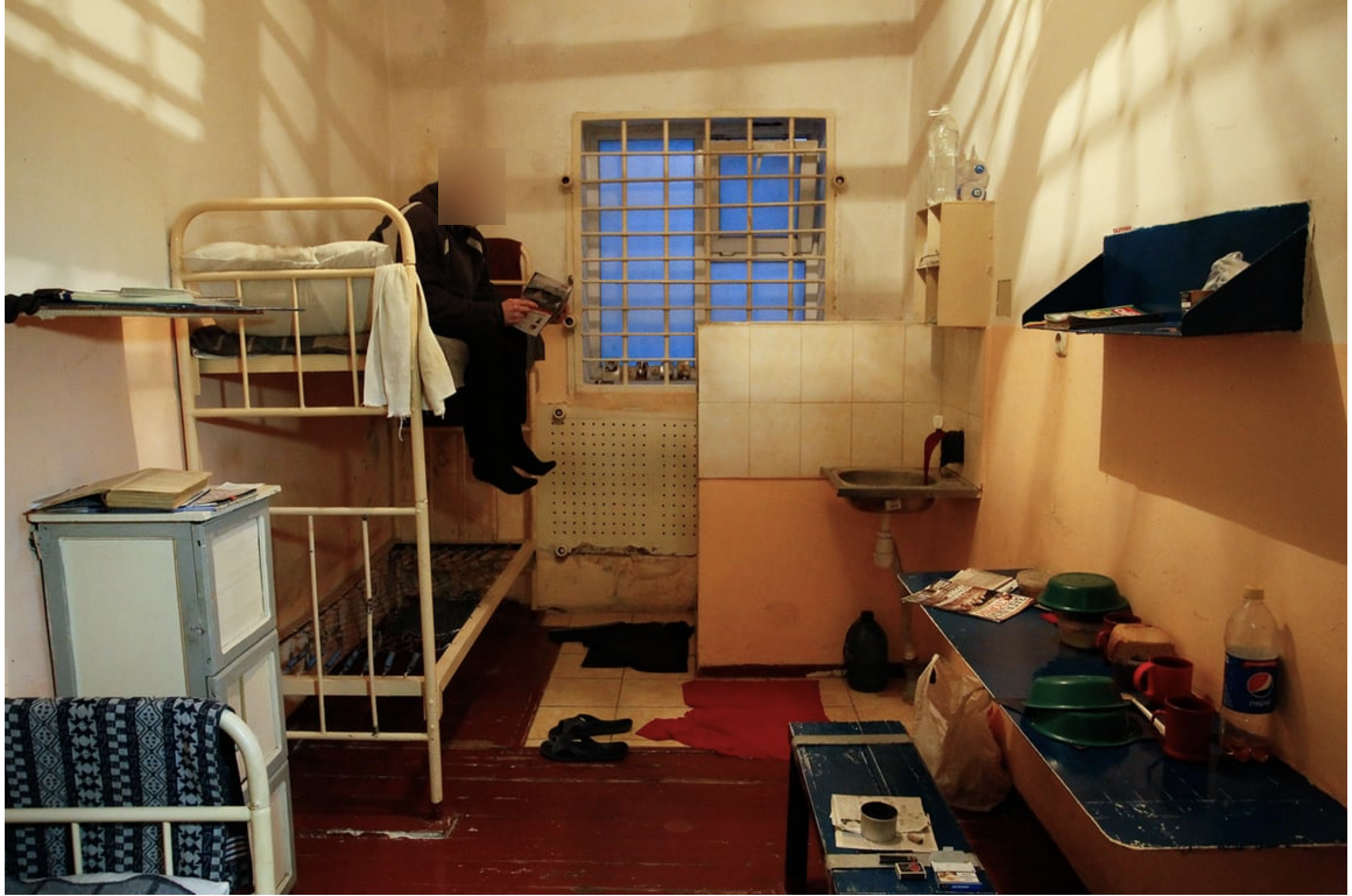 Cell in Makiyivka Colony No. 97. Photo credit: Aleksandr Yermochenko / EPA
In the colony, the sector that used to be the disciplinary isolation ward, where prisoners were punished, was turned into an FSB pre-trial detention centre. We were held there. It was a two-storey building with a basement, where the punishment cell was located. There were small cells for four people.
How did the colony differ from “Izolyatsia”?
“Izolyatsia” was a painful and difficult ordeal. In the colony, it was different.
After Izolyatsia, we were “trained”, and the guards asked us why we were so scared. As soon as the doors opened, we immediately jumped out of bed and faced the wall. They told us to relax because they didnʼt care. Only the curator was an FSB agent who read our letters, but the guards did not. Sometimes they beat us, but usually not for made-up reasons, as in “Izolyatsia”. I could be punished for the blade from a disposable razor that I always carried with me in case I wanted to end my life. This habit remained after “Izolyatsia”.
In the colony, there were hour-and-a-half walks, but I didnʼt go on them and stayed in my cell. I slept all day or read science fiction or fantasy. Books could be taken from the library or ordered. We could also play backgammon, chess and checkers.
The food here was better, the portions were larger, but the food itself was disgusting because it was cooked by prisoners. We were saved by parcels from our families. We shared them between cells because we had a “principle of humanitarian aid”.
In the colony, you have time to think, especially at night when everyone is asleep. In “Izolyatsia”, since there were 21 people there, you had someone to talk to.
When the full-scale war began, they brought a TV to our cell to show us their missiles flying into Ukraine. They told us how quickly they were taking everything over. And you realise that the exchange may not happen. And so you sit there for six months, a year, two years… In the same cramped conditions, with no prospects. Meaning that, at that point, you start killing yourself from the inside.
Did you receive medical care in the colony?
There was an elderly nurse who gave everyone one pill for everything. I suffered from asthma, and she experimented on me: “We have two drugs, but they donʼt help you. What if we mix them? What if we add a third one?” I donʼt know what she injected me with, but the director of the Donetsk cancer hospital was sitting in our cell, and he said, “Dania, when you get out, your liver will fail“. But, thank God, everything is fine.
Who did you share a cell with in prison? Were you transferred to other cells?
Yes, I was transferred twice. In one of the cells, I shared a cell with two entrepreneurs from Donetsk and a doctor. In the other cell, there was a Jordanian, a communist, and an ideologist of the Russian world. There was a certain DPR activist, historian, and philosopher, Roman Manekin. An acquaintance of Duginі . At the beginning of the war, he appealed to Akhmetov to switch sides to the “DPR”. He is a despicable Russian boor, but I had to live with him in the same cell.
I served my sentence in the colony until June 2023, and then I was placed under a six-month travel ban. I tried to escape from Donetsk through the Luhansk region to Russia in order to go to Europe. But after the pseudo-referendum in Luhansk, there was the same base there as in Donetsk, and I was sent back.
Daniil, why do you think they let you go?
I was released only because I had no interrogation report, no witnesses, and no proper polygraph test. The “judge” looked at it and said that the case should be closed. Similar cases, like mine, which there were about three hundred of, were closed, and the people were released.
Before that, they transferred us to Russian legislation – from Article 321 to 276 – so that people would remain in their database.
Was it because of this that you were released under a travel ban?
Yes. Then I tried to leave via Russia and LBZ (Avdiivka), but I didnʼt succeed. In Donetsk, I got a job with the local Roma community. I sold phones in their shop at the Maiak market. Russians paid double the price, locals paid the normal price.
Around New Yearʼs Eve, I got a call from the investigator, who said he had a New Yearʼs gift for me. He gave me a letter saying that my case had been closed due to a lack of evidence. They returned all my documents, but my passport was already invalid because I did not have the new photo affixed on time, and on top of that, it had been torn during my arrest.
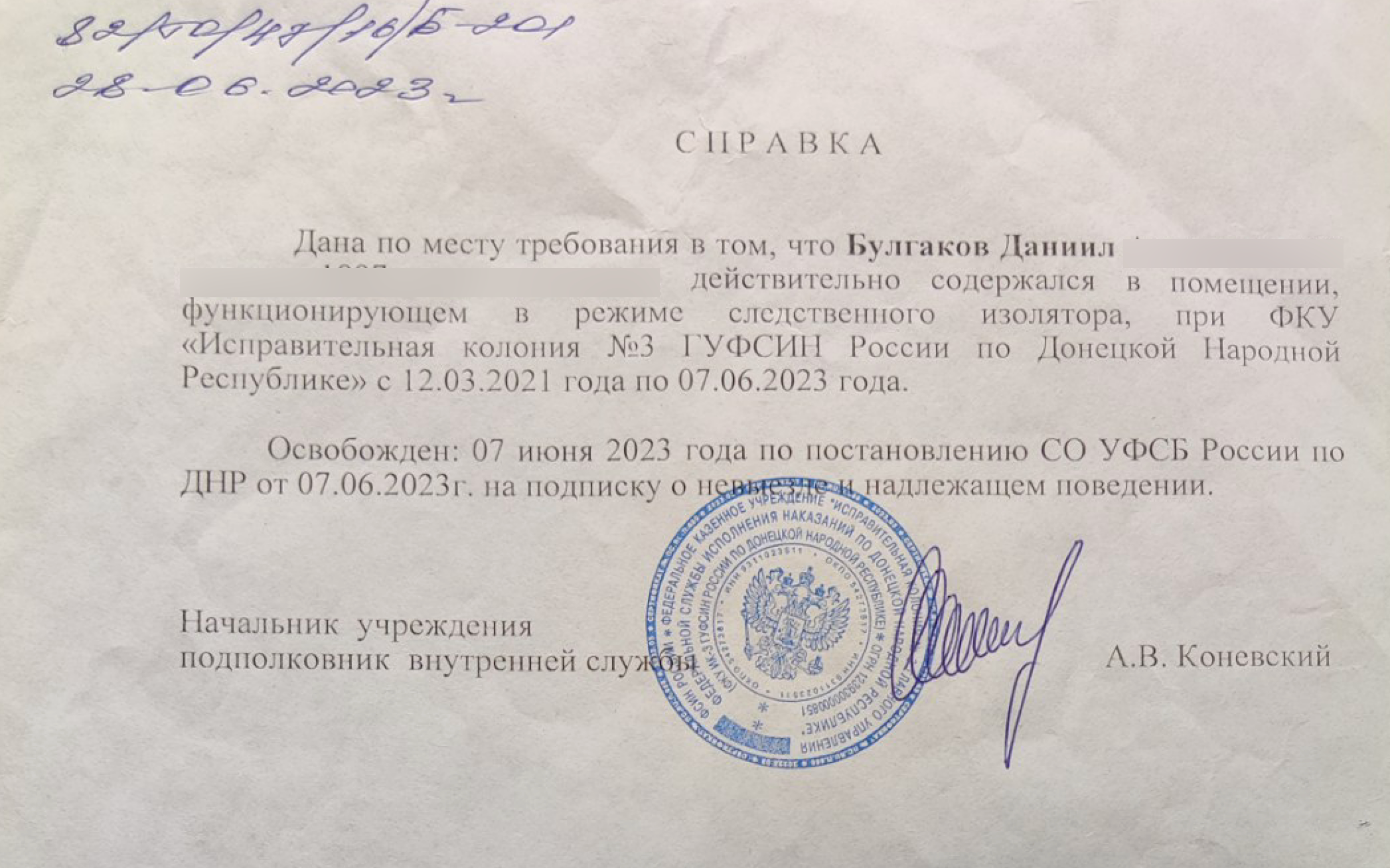 Photo credit: ZMINA
I travelled to Belarus, but because of my passport, I was not allowed into Poland. Without thinking twice, I went to the Ukrainian embassy in Minsk. There, they told me they couldnʼt help me. The locals advised me that there was a border crossing between Belarus and Ukraine. It was closed, but in emergencies like mine, you could get through. I went there and said that I had been held captive and wanted to return to Ukraine.
While the Belarusian border guards were processing my documents, they questioned me all day. In the evening, they let me through. It was already January 2024. I approached our checkpoint, and the Ukrainian border guard asked who I was. I said I was a prisoner, and he told me to come back tomorrow. Which I did. So the next day, I crossed the border. They took me to Kovel, and from there I took a train to Kyiv.
Language support: ZMINA volunteer Lisa DeHaven