Ukrainian police and emergency services defend restrictions on journalists after 42 emergency responders were killed in repeat Russian strikes
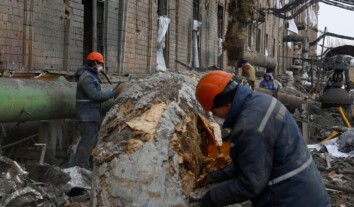
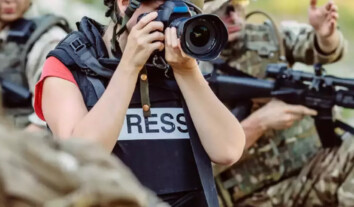
Since the onset of Russia’s full-scale invasion, 42 employees of the National Police and the State Emergency Service (SES) have been killed and another 129 seriously injured in repeated strikes while on duty, officials reported. Because of the threat of repeated strikes, law enforcement officers and rescue workers stressed the need to restrict access to emergency rescue sites, particularly for journalists.
 Photo credit: IFJ
Representatives of the National Police and the State Emergency Service presented these details during a joint meeting of the parliamentary Committee on Freedom of Speech and the Temporary Investigative Commission investigating Russian crimes against journalists and other media workers, ZMINA reported.
First Deputy Head of the Main Investigation Department of the National Police *Serhii Pantelieiev* presented statistics on investigations into war crimes committed against journalists.
According to Pantelieiev, police are investigating 76 criminal proceedings in this category. These include 21 cases of journalists being killed, 24 cases of journalists being wounded, 14 abductions and 13 cases of severe injury during shelling.
Pantelieiev said that when working at the scenes of Russian strikes, law enforcement officers must first and foremost guarantee people’s safety and collect evidence of war crimes.
He cited the example of the 2 November Russian attack on the settlement of Komyshuvakha in the Zaporizhzhia Region (Oblast), when Russian forces launched a series of repeated air strikes on a local school building. The police representative said that the threat of repeated attacks persists even after emergency services arrive, so journalists need to take a responsible approach to their own safety.
SES representative *Svitlana* explained that cordon tape around an emergency site is necessary not only to preserve physical evidence, but also to protect people working in the area.
According to her, search and rescue operations take place behind the cordon tape, and the incident commander is responsible for everything occurring within that perimeter.
In addition, heavy machinery operates on site, and drivers cannot always see people around them. The presence of unauthorised persons in such an area creates additional risks.
The State Emergency Service representative also elaborated that cordoning helps prevent looting in damaged buildings and restricts access to areas where emergency operations are still underway.
At the same time, she acknowledged that there is no uniform procedure across different regions for clearing reporting materials from strike sites. In some oblasts, this is handled by military administrations, while in others it is done by the Security Service of Ukraine (SBU). According to her, there are instances where journalists have been prohibited even from publishing information about civilian sites.
Meeting participants also discussed the issue of rapid communication between journalists and law enforcement agencies.
In particular, a representative of a Kyiv media outlet proposed setting up a joint communication chat where newsrooms could quickly receive verified information about Russian strike locations that journalists should not visit due to danger or the work of investigators.
She explained that journalists often find it difficult to obtain comments from law enforcement officers in the mornings, forcing newsrooms to rely on unverified information from Telegram channels.
The SES representative did not support this suggestion. The service already operates numerous working groups, and journalists can call SES press officers directly, who are expected to be reachable round the clock, she said.
She also said that during large-scale emergency response operations following strikes, press officers are instructed to set up designated media areas as close to the scene as safety permits.
Meeting participants also addressed the dissemination of information about the aftermath of Russian attacks on social media. Media representatives noted that journalists follow rules on delaying the publication of sensitive information, whereas anonymous Telegram channels often circulate videos and details about strike locations immediately.
According to a representative of the Institute of Mass Information (IMI), cases have been recorded in Zaporizhzhia Oblast and Kharkiv, where journalists were hindered from working at strike scenes involving civilian sites, with the accusation that their publications supposedly led Russian forces to carry out repeat strikes.
In response, the IMI submitted a memorandum on cooperation between the media and law enforcement agencies to the Office of the Prosecutor General. The document focuses primarily on journalists working at strike scenes involving civilian sites. Plans are under way to update it and resume the work of an interagency group to assist in documenting Russian war crimes.
Summing up the meeting, participants stressed the need to update existing rules for journalists working under martial law to account for new threats, particularly double- and triple-tap strikes.
Between February 2022 and October 2025, analysts were able to confirm 401 cases of double-tap strikes carried out by Russia against rescue workers, resulting in deaths or injuries.
Want more insight from Ukraine’s human-rights story? Follow ZMINA on X, Bluesky and LinkedIn – and share what matters to you via this short survey here.