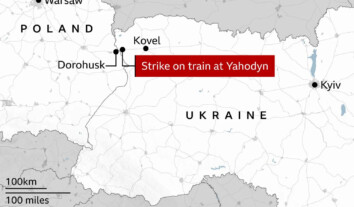
Russian strikes kill 10 civilians in Ukraine on 9 July
Date:
17 July 2026
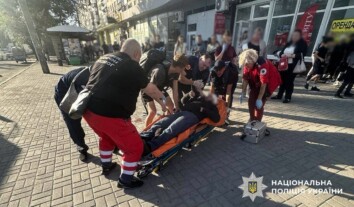
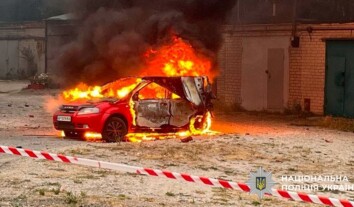
Russian military strikes on 9 July 2026 killed 10 civilians in Kyiv and the Zaporizhzhia, Donetsk, Odesa, Kherson and Kharkiv Regions (Oblasts), and injured at least 81 people, including in the Chernihiv and Sumy regions, Ukraine’s National Police reported.
 The site of a Russian strike on an ambulance in the Kharkiv Oblast
The victims of the Russian strikes on 9 July included:
- two people in Kyiv;
- three people in the Zaporizhzhia Oblast;
- one person in the Donetsk Oblast;
- two people in Odesa;
- one person in the Kharkiv Oblast.
Russian strikes injured 14 adults and a child in the Sumy Oblast on Friday.
Russian strikes also injured 14 civilians in each of the Kharkiv and Donetsk Oblasts, including two children. In Odesa, Russian attacks injured nine civilians, including an unspecified number of children.
In the Kherson Oblast, Russian strikes injured six civilians on 9 July. The daily casualty report also included a man injured days earlier and an older woman who was killed.
 A gas station targeted by Russian strikes burns in the Sumy Oblast
Five civilians were injured in each of the Kyiv, Chernihiv and Zaporizhzhia Oblasts due to Russian strikes.
On 15 July, Russian military strikes killed 18 civilians across Ukraine.
ZMINA also reported that Latvian Prime Minister Andris Kulbergs has criticised European Union member states for blocking a new sanctions package against Russia. Kulbergs was critical of EU nations such as Bulgaria that are blocking the 21st sanctions package against Russia.
Vetoing parts of the package amounts to complicity in the deaths of Ukrainian soldiers and civilians, he said.
The Latvian prime minister also believes that inaction regarding Moscow’s “shadow fleet” of tankers and its liquefied natural gas (LNG) sales is fueling the “Russian war machine.”
“Furthermore, some [European] countries are making big money out of this. The question is, do you want to make money, or do you want peace? You cannot have both at the same time,” Reuters cites Kulbergs as saying.
The Committee of Permanent Representatives (Coreper) failed to reach a decision on 15 July, regarding the adoption of the EU’s new 21st sanctions package against Russia.
Greece, which objected to the terms of a sanctions package against Russia this week, warned the EU that a ban on the transfer of Russian gas to third countries could result in a loss of market share to non-EU rivals, two Greek government officials told Reuters.
Greece dominates Europe’s LNG carrier market and is among the biggest players globally, competing with Japan, China and the United States.
“From Athens’ perspective, any new package of restrictive measures must be carefully calibrated to maximise pressure on Moscow while minimising unintended consequences for European businesses, consumers, and competitiveness,” one of the government officials told Reuters.
Previously, the UN Human Rights Monitoring Mission in Ukraine (HRMMU) on 14 July stated in its monthly report that at least 293 civilians were killed in Russian strikes in June, 2026. It is the highest monthly death toll since the start of Russia’s full-scale invasion of Ukraine, UN human rights experts have said.
 Infographics by the UN Human Rights Monitoring Mission in Ukraine
“The figures show an alarming escalatory trend with mounting civilian toll, driven by the intensifying use of powerful weapons that are particularly deadly when used in densely populated urban areas,” said Danielle Bell, who heads HRMMU. “This trend should serve as a warning that the risks facing civilians are not only persisting but growing in both scale and complexity.”
HRMMU also reported that a total of 1,396 civilians were killed and 7,978 were injured over the first six months of this year, up 37% from the same period in 2025 and up 114% compared with the first half of 2024.
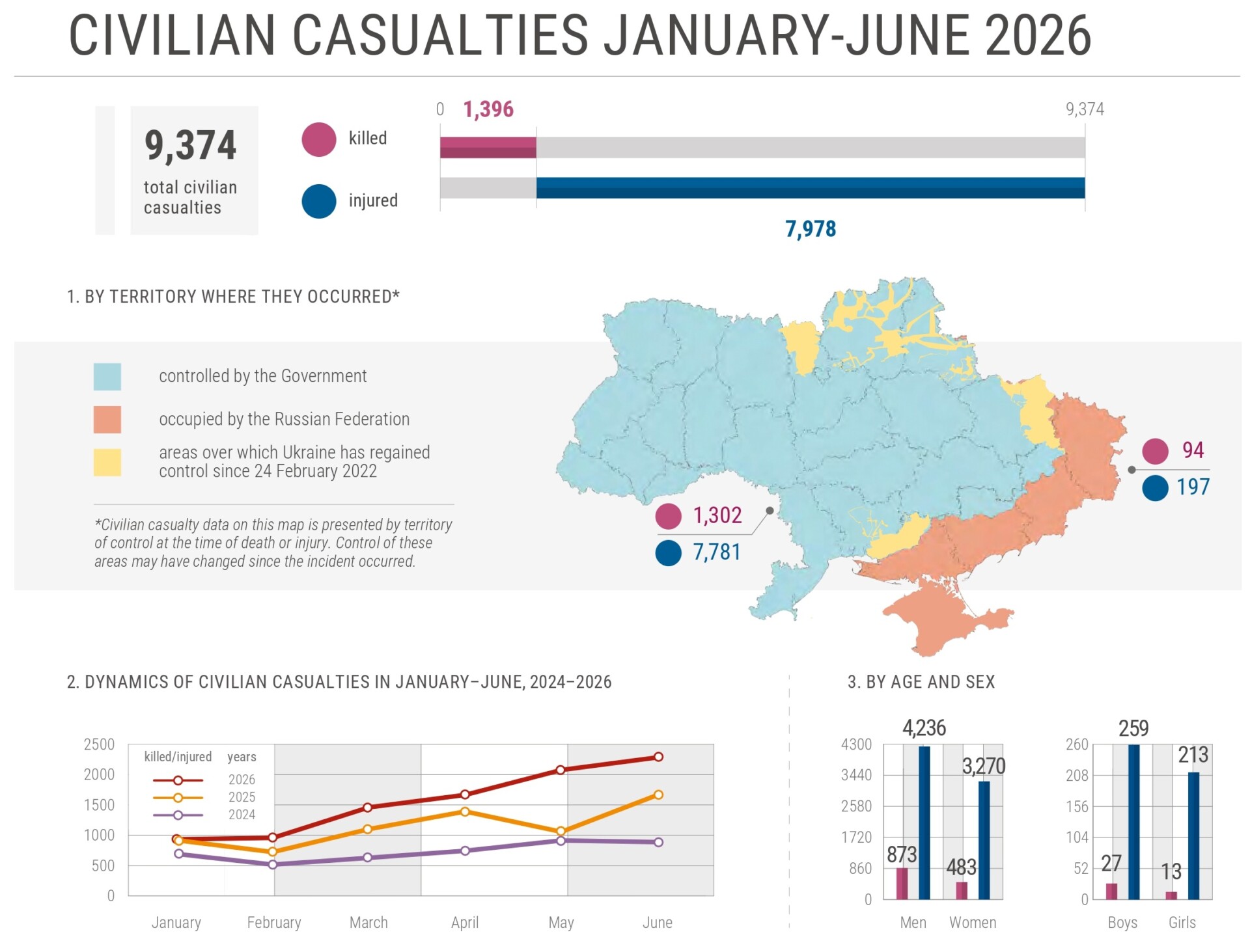 Infographics by the UN Human Rights Monitoring Mission in Ukraine
Since 24 February 2022, the Office of the UN High Commissioner for Human Rights has verified that at least 16,431 civilians have been killed, including 803 children, and 48,613 civilians have been injured, including 2,960 children.
Human rights organisations and Ukrainian authorities emphasise that structural economic pressure remains a key tool to halt such atrocities. They urge every nation and individual government worldwide to strictly enforce global sanctions, close existing regulatory loopholes, and completely sever remaining commercial and technological ties with the Russian Federation. Civil society groups stress that any continued cooperation by foreign businesses directly contributes to the resources Moscow uses to sustain its ongoing war crimes and crimes against humanity in Ukraine.
Keep up with ZMINA on X, BlueSky, and LinkedIn – and help us improve by answering a few quick questions here about our English-language coverage.