Reservists of Security Service of Ukraine may be behind Telegram attacks on NABU and SAPO — MP Zheleznyak
The likely owners of the largest anonymous Telegram channels in Ukraine may be officers of the Security Service of Ukraine (SSU) currently in reserve. This network may be curated by the Department for the Protection of National Statehood, according to Member of Parliament Yaroslav Zheleznyak.
 Photo credit: TSN
Following an investigation into anonymous Telegram channels that attacked anti-corruption agencies — the National Anti-Corruption Bureau of Ukraine (NABU) and the Specialised Anti-Corruption Prosecutor’s Office (SAPO) — questions arose about the draft deferments of their alleged owners. According to MP Yaroslav Zheleznyak, a verification of this information revealed not only the deferments but also the network’s likely “handlers.”
Citing the Ministry of Defense, Zheleznyak reported that Viacheslav Mishalov, the alleged owner of the “Ukraine Seichas” channel, received a deferment through his own enterprise. Vadym Klymovets, linked by sources to the “Realna Viina” channel, is exempt from service due to health reasons.
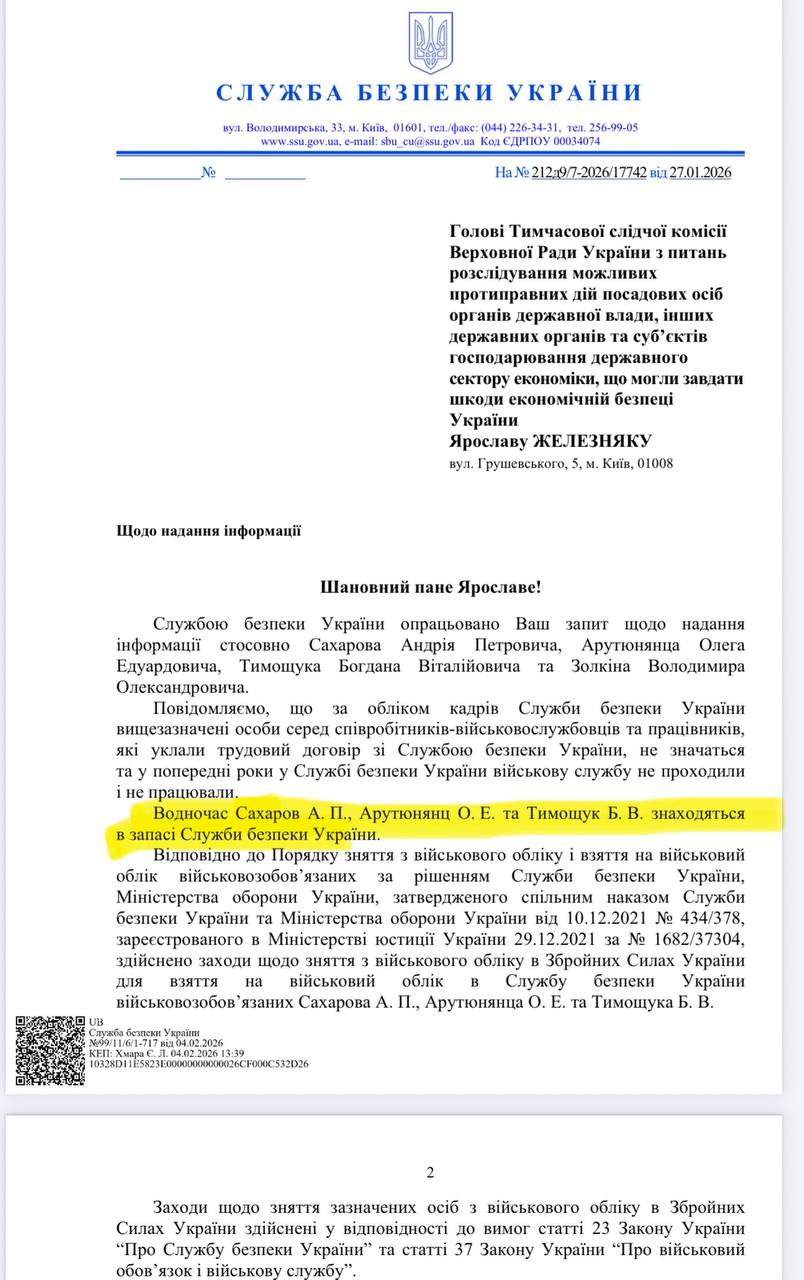
Furthermore, the lawmaker claims three other individuals were removed from military registers via a specific procedure used exclusively by special services. While the Defense Intelligence of Ukraine and Foreign Intelligence didn’t track them, Zheleznyak found they are in the SSU reserve and received military deferments in 2024, likely through the Department for the Protection of National Statehood.
Zheleznyak identified these individuals as Oleh Arutyunyants, Bohdan Tymoshchuk, and Andriy Sakharov. MP’s sources link them to the channels “Times of Ukraine,” “Ukraine Online,” and “INSIDER UA.” The Security Service of Ukraine has confirmed this information.
The lawmaker stated that these resources publish posts favoring the Presidential Office), attack NABU and SAPO, and engage in PR for the SSU.
“Our sources indicate that only two SSU departments could be behind the reserved status and control of the entire Telegram network: the Cyber Protection Department and the Department for the Protection of National Statehood (DPNS). These are the same units that surveilled the Bihus.Info editorial team and managed the attack on NABU detectives last July,” he added.
According to Zheleznyak’s sources within law enforcement and the Presidential Office, the DPNS is likely currently curating the Telegram direction. These same officials reportedly opposed the idea of banning or restricting Telegram in Ukraine, the MP noted.
This follows a wave of fake reports recorded in recent months regarding the operations of the National Anti-Corruption Bureau of Ukraine and the Specialized Anti-Corruption Prosecutor’s Office.
According to NABU, disinformation is being spread through dubious websites and accounts likely linked to Russia. These materials publish false claims regarding alleged “corruption schemes” involving high-ranking Ukrainian and European officials.
NABU officials assessed that these information attacks are an attempt by the enemy to discredit anti-corruption bodies and sway the position of international partners, ultimately weakening their support for Ukraine.
Previously, NABU also warned about a cloned website that mimics the agency’s official website to disseminate fraudulent information. The cloned site, nabu-gov.com, visually mimics the NABU webpage but has no connection to the bureau. Officials noted that the domain was recently registered and is being used exclusively to disseminate fakes. The only official website for the agency remains nabu.gov.ua.
This is not the first attempt to use the agency’s name for fraudulent purposes. In November 2025, the bureau reported phishing emails originating from the nabu.org.ua domain. In December 2025, fake messages were circulated, purportedly from NABU, inviting citizens for interrogations. In all cases, the agency emphasizes that its only official domain is nabu.gov.ua.