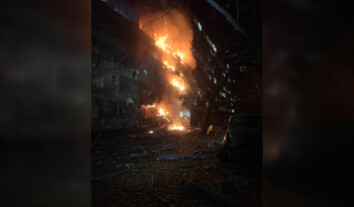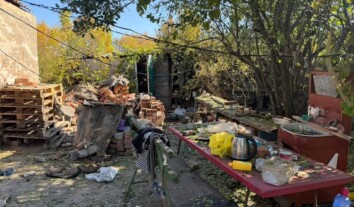
Russian nighttime attack in Kharkiv region leaves five civilians injured
Five civilians were wounded as a result of Russian shelling in the Kharkiv region during the night of February 16, 2026, according to the Kharkiv Oblast Prosecutor’s Office.
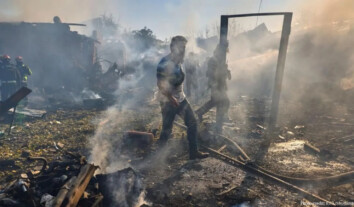
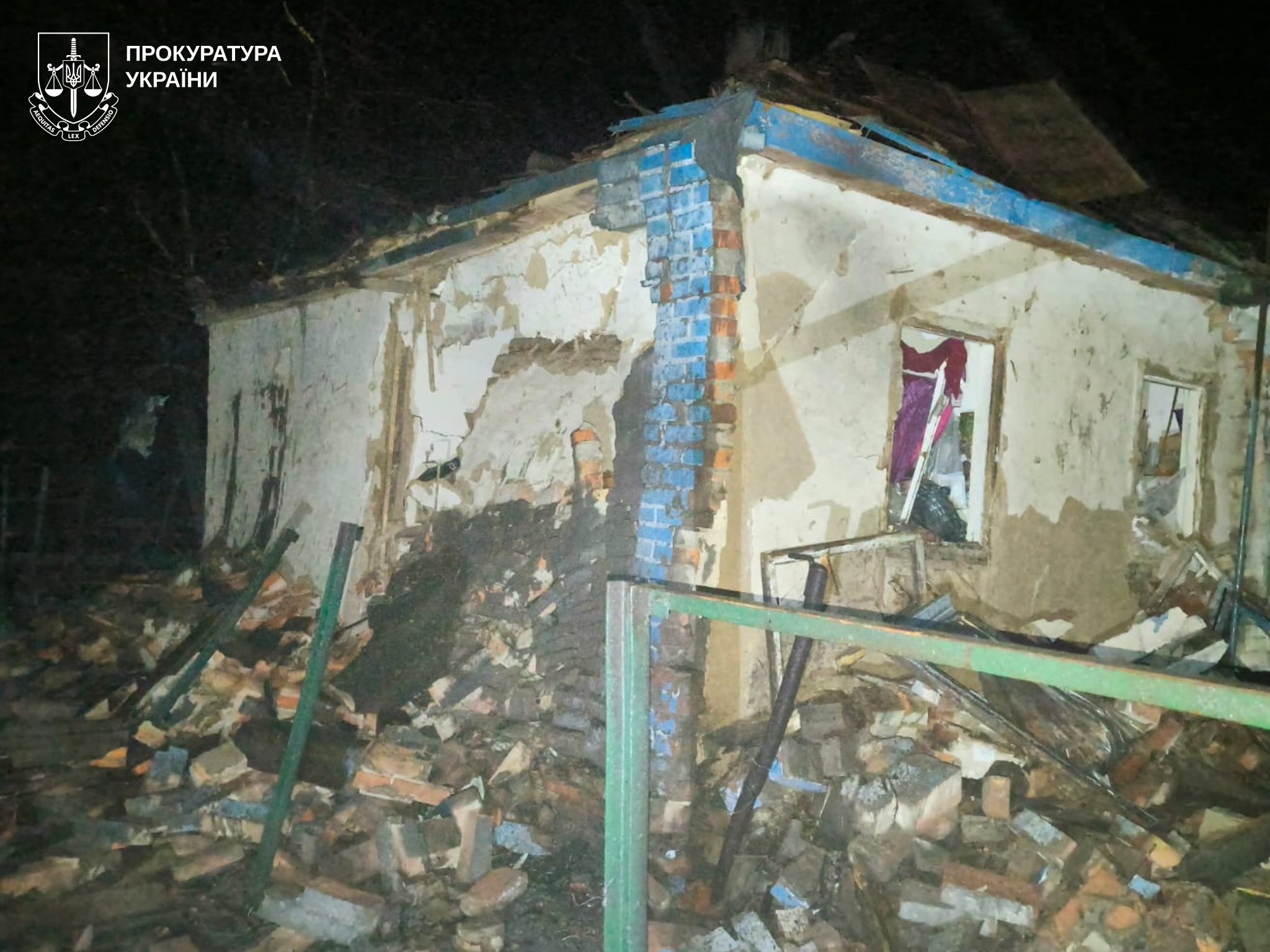 A house ravaged by a Russian strike in the village of Tetianivka
The Russian military struck the village of Tetianivka in the Kupiansk District. Preliminary data suggests that a “Geran-2” strike drone was used in the attack.
Photos released from the scene show a ravaged house. Among the victims is a 15-year-old girl. No further details regarding the condition of the civilians have been provided.
On the night of February 15-16, Russian forces attacked Ukraine using four Zircon hypersonic cruise missiles, an Iskander-M ballistic missile, a Kh-31P anti-radar missile, and 62 Shahed, Gerbera, Italmas, and other types of drones, Ukraine’s Air Force said.
Early reports indicated that as of 9 a.m., Ukrainian air defense forces had destroyed or jammed two Zircon hypersonic cruise missiles and 52 Shahed, Gerbera, Italmas, and other types of drones.
Ukrainian forces recorded hits by one missile and nine drones at eight locations and debris from downed aerial assets at two locations.
The Air Force said it is confirming information about three other missiles.
The press service of NPC Ukrenergo reported that, as a result of enemy strikes on energy infrastructure, consumers in four regions of the country are experiencing power outages as of this morning. The blackouts have affected the Donetsk, Dnipropetrovsk, Cherkasy, and Odesa Oblasts. In particular, a significant portion of consumers in Odesa remain without electricity following drone strikes.
To provide background, Ukrainian experts point out that countries including China, North Korea, Hungary, Slovakia, Iran, and Brazil assist Moscow in killing Ukrainians in its war against Ukraine by funding the Russian budget through trade.
Previously, Reuters reported that China’s Russian oil imports are set to climb for a third straight month to a new record high in February as independent refiners snapped up deeply discounted cargoes after India slashed purchases, according to traders and ship-tracking data. Russian crude shipments are estimated to amount to 2.07 million barrels per day for February deliveries into China, surpassing January’s estimated rate of 1.7 million bpd, an early assessment by Vortexa Analytics shows.
Earlier, Bohdan Bernatskyy, a member of the Sanctions Policy Working Group of the Crimean Platform Expert Network, revealed at the Third Parliamentary Summit in Latvia that over 1,300 Russian military companies and 2 million industrial workers continue to operate, many without international restrictions.
Defense Intelligence of Ukraine (DIU) has released detailed data on 39 enterprises that are part of the Russian “Kalashnikov” Concern on its War&Sanctions portal. Intelligence highlighted that despite their critical role in military production, nearly half of the concern’s enterprises are still not under sanctions by any country in the sanctions coalition.
Intelligence officials noted that while the holding is traditionally associated with small arms, it is actually a multi-profile element of the Russian military-industrial complex directly involved in fueling the war against Ukraine.
“The concern’s enterprises manufacture reconnaissance and strike UAVs, guided artillery ammunition, high-speed landing craft, equipment for the Russian armed forces, as well as machine tools for other Russian defense enterprises,” DIU emphasized.
Earlier, DIU also released data on 21 Russian enterprises involved in the development and production of unmanned systems used by the aggressor state in the war against Ukraine.
The update specifically includes:
-
LLC “Agency for Digital Development” – Developer and manufacturer of the “Svarog” line of cargo UAVs. These drones have been used by enemy marine units to supply occupation forces on islands in the Dnipro River delta in the Kherson Oblast.
-
“Aero-hit” Group – Developer and manufacturer of “Veles” FPV drones. According to DIU, these companies belong to Konstantin Basyuk, the so-called Russian senator from the temporarily occupied Kherson region, and receive state funding from the Russian budget.
-
KB “Microb” – Developer of the eponymous series of FPV drones, and JSC “Ploshchad”, which creates autopilot and machine vision systems for them.
According to intelligence reports, part of the published information was provided by participants of the War&Sanctions international hackathon, organized by DIU last year.
Stay connected via X and LinkedIn with ZMINA – and help build this platform with us by filling out our anonymous 5-minute survey here.