What the EU Shadow Report is and how independent experts assessed Ukraine’s progress over the past year
Ukrainian independent experts have been analysing the state of reforms and the government’s fulfilment of its European integration commitments for the past two years to present their findings to the European Union.
At the end of October, they presented this Shadow Report to the European Commission’s 2024 Report on Ukraine, covering Chapters 23 “Justice and Fundamental Rights” and 24 “Justice, Freedom and Security”, which are of crucial importance in the negotiation process for the country’s accession to the EU.
This year’s report is the second such analytical document prepared by a coalition of civil society organisations for the European Commission. Experts pointed out positive developments and critical issues that require urgent resolution.
Below are the main findings of civil society on Ukraine’s progress toward EU accession over the past year, particularly in the areas of justice and fundamental rights.
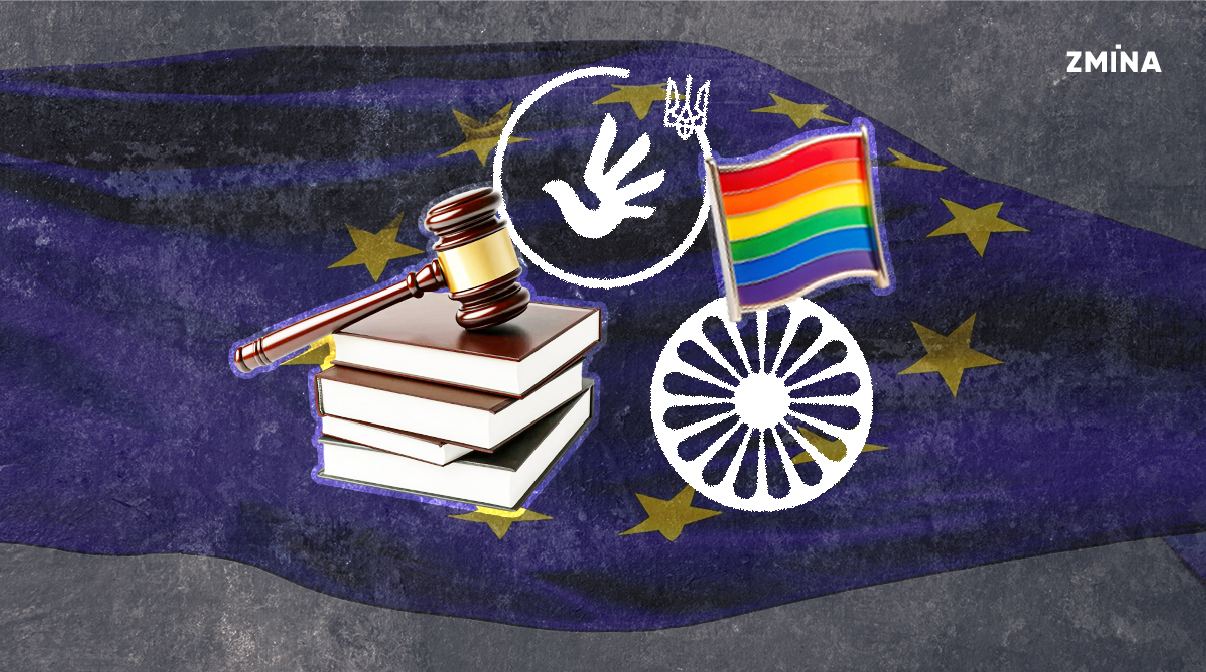
What is the Shadow Report in the EU integration process
As part of its preparations for EU accession, Ukraine must implement a series of reforms and harmonise its legislation with EU law. The European Commission assesses the progress of candidate countries on an annual basis, examining both official government reports and independent reports from think tanks and civil society organisations. The preparation of shadow reports is a regular practice for all candidate countries seeking to join the EU.
The Shadow Report is an independent alternative assessment of the work of the government and other official structures in fulfilling the criteria for EU accession, explained Andrii Borovyk, Executive Director of Transparency International Ukraine, in a column for Ukrainska Pravda:
“Such a document is prepared by experts and civil society at the request of European partners – it offers an external, independent view of the reform process in the country. Importantly, the EU does not interfere in the preparation of the conclusions; civil society organisations that draft the report bear full responsibility for its content“.
The alternative report produced by civil society is necessary to balance the results presented by the government, which often focuses on its achievements. Independent experts, on the other hand, take a more critical approach to assessing the progress of European integration reforms, pointing out the key problems and shortcomings in their implementation.
Through the Shadow Report, the European Commission receives a broader assessment of what the Ukrainian authorities have actually implemented from the recommendations previously issued by the EU. Experts not only identify existing problems but also propose ways to address them.
A coalition of civil society organisations prepared the Shadow Report to the European Commission’s Report on Ukraine in 2024, covering Chapters 23 (“Justice and Fundamental Rights”) and 24 (“Justice, Freedom and Security”) of Negotiating Cluster 1, “Fundamentals of the EU Accession Process.” This Negotiating Cluster is the first of six to open and the last to close. Ukraine’s accession to the EU will depend on progress in these areas.
The document covers, in chapters 23 and 24, progress and challenges in the areas of the rule of law, the fight against corruption and organised crime, the protection of fundamental rights and freedoms, visa policy, and migration.
This year’s Shadow Report contains over 500 recommendations on approximately 1,000 pages. Last year, a coalition of civil society organisations prepared an alternative analysis to the European Commission’s report for the first time. The document received high praise from the European Commission, and its recommendations were incorporated into the Rule of Law Roadmap, which sets out the reform progress required to open accession negotiations under Cluster 1.
How the government responded to the civil society report
Dozens of leading experts took part in preparing the Shadow Report, said Svitlana Matviienko, executive director of the NGO Agency for Legislative Initiatives, during the report’s presentation on October 23.
According to Matviienko, about 200 interviews were conducted with representatives of state and judicial authorities and various institutions. Therefore, a “shadow report” does not mean that the document is “oppositional.”
Taras Kachka, Deputy Prime Minister for European Integration, assessed this year’s Shadow Report as showing progress in reforms in the areas of anti-corruption, the rule of law, and justice. He noted that the daily work of independent institutions is often more important than “achievements”.
“Statistics from the National Anti-Corruption Bureau and the High Council of Justice show that they are functioning well, so we have made incredible progress in terms of reforming the rule of law“, the government official noted.
According to Iryna Mudra, Deputy Head of the Office of the President, the preparation of the Shadow Report demonstrates the maturity of civil society and the authorities, who are ready for constructive dialogue.
“This Shadow Report is a very important instrument for our further processes“, Mudra noted.
The importance of the Shadow Report for the government was also highlighted by Liudmyla Suhak, Deputy Minister of Justice of Ukraine for European Integration:
“Last year, when we were preparing for the screening, we were very happy to receive the Shadow Report before our trip to Brussels. It served as a guide for us, showing us what still needed to be done“.
She added that the Ministry does not view the Shadow Report as oppositional — the document highlights many sound ideas that deserve attention, and constructive criticism enables progress.
Persistent challenges and slow progress in justice and anti-corruption reforms
In the Shadow Report, experts noted that in many areas, reforms have slowed or persistent problems remain unresolved as of 2024.
In particular, from September 2024 to July 2025, some judicial and constitutional justice reform processes slowed compared with the previous year.
The report identifies the most significant problems as the suspension of the work of the Grand Chamber and the Second Senate of the Constitutional Court of Ukraine, pressure from the State Bureau of Investigation on the High Qualification Commission of Judges, the failure of the competition for the High Anti-Corruption Court, delays in the creation of higher administrative courts, and new schemes of large-scale corruption in certain courts.
The analytical document lists positive changes:
- The launch of the Service of Disciplinary Inspectors of the High Council of Justice;
- The dismissal of a number of corrupt judges;
- The approval of uniform indicators for assessing the integrity and professional ethics of judges;
- The appointment of local court judges;
- The start of the selection of candidates for 1,800 vacant positions of judges in local courts;
- progress in the competition for appeal courts and
- The adoption of a law on the creation of two higher administrative courts.
The Shadow Report notes that the judiciary continues to face traditional problems of excessive workload, shortage of judges, low funding, and interference with the independence of the judiciary:
“A separate issue that has become relevant since June 2025 is the end of the term of office of international experts in the competition commission for the selection of the High Qualification Commission of Judges of Ukraine, which requires immediate action“.
Particular attention is paid to the fight against corruption and the authorities’ attempt in July 2025 to strip the anti-corruption bodies – NABU (National Anti-Corruption Bureau of Ukraine) and SAPO (Specialised Anti-Corruption Prosecutor’s Office) – of their independence.
The report states that on July 22, 2025, a law was passed in violation of democratic procedures, and peaceful protests and statements by civil society organisations failed to persuade the president to veto it. As a result, the institutional independence and autonomy of SAPO and NABU were jeopardised for nine days:
“Although the harmful Law No. 4555 was almost completely deactivated on July 31, 2025, some of its provisions are still in force and may have negative consequences, as may the controversial provisions of the adopted Law No. 4560″.
You may also want to read: Systemic pressure on the anti-corruption ecosystem: challenges facing NABU, activists, and the media in 2025
Analysts also noted certain positive developments in the work of anti-corruption institutions. In particular, these include the large-scale recruitment of new employees to NABU and SAPO, the approval of NABU’s development strategy, the initiation of work on SAPO’s institutional development strategy, and the adoption of a law enhancing the procedure for concluding agreements in corruption cases. They also noted the Supreme Court’s formulation of important legal positions on the distinction between official crimes and the NABU’s measures to improve information security.
Gaps in the field of fundamental rights
In the field of fundamental rights, there are two frameworks that apply exclusively to all human rights, noted Tetiana Pechonchyk, the Head of the Board of the Human Rights Centre ZMINA, during the presentation of the Shadow Report.
The first is the National Human Rights Strategy, which was first adopted in 2015 and now needs to be updated. This is a basic document that defines the key vectors of activity in the field of human rights protection in Ukraine. To implement it, the government approved an action plan for 2021–2023.
In autumn 2022, the Ministry of Justice initiated an update to the strategy’s provisions, taking into account the challenges posed by the Russian Federation’s full-scale invasion. Representatives of human rights organisations were invited to submit proposals for updating the document’s text. Proposals from these authorities and civil society organisations were reviewed and forwarded to the Office of the President in 2023. However, the strategy was not updated, and the action plan for its implementation after 2023 was not approved.
At the same time, the proposals developed in 2022–2023 are no longer relevant, according to the Shadow Report’s experts. Therefore, it is necessary to start collecting proposals again to update the strategy and develop actions for 2026–2028.
On June 4, 2025, the Ministry of Justice withdrew draft presidential decree No. 119 (dated March 24, 2021), which proposed updates to the strategy developed in 2023. This was due to the need to align the strategy with the Rule of Law Roadmap. At the end of July 2025, the ministry invited civil society organisations to submit proposals for updating the strategy.
In the Shadow Report, experts recommend updating the national human rights strategy in light of the challenges of 2025 and approving an action plan for its implementation by 2028.
“It is very important that we have a clear roadmap of where we are strategically heading, what we need to do, and that a new action plan is developed for this strategy”, Tetiana Pechonchyk said.
The second important issue is the institution of the Ukrainian Parliament Commissioner for Human Rights, which is also responsible for protecting all human rights without exception.
“It is very important for us that this institution is competent, independent, and has adequate financial resources for its activities”, Pechonchyk added.
According to Pechonchyk, the current law on the Ukrainian Parliament Commissioner for Human Rights is quite outdated and needs to be reformed. In the spring, a package of updated draft laws was submitted to parliament, containing many important changes but also significant gaps.
“These draft laws do not contain two key elements. The first is public participation, in particular by the human rights community, in the procedure for selecting the Ombudsman, as provided for in the UN Paris Principles. This was removed from the draft laws at the time of registration“, the human rights advocate pointed out.
The second important point is a “landmine” threatening the institutional independence of the Ombudsman. After the introduction of martial law, the parliament introduced the possibility of dismissing the Ombudsman through a vote of no confidence.
The Shadow Report notes that the new version of the law on the Commissioner contains a number of positive changes: lowering the age limit for candidates for the position of Commissioner from 40 to 35 years, introducing a procedure for appointment to this position with a clear definition of the terms for each stage of the process.
The Ombudsman is proposed to be given the right to submit proposals for the ratification of international human rights treaties. Also, the right to facilitate the documentation of war crimes and gross human rights violations, the right to facilitate the return of Ukrainian citizens from the territory of the aggressor state and their departure from the temporarily occupied territories (TOT) of Ukraine, and to submit proposals to parliament for the creation of a temporary investigative or special commission.
At the same time, the authors of the report emphasise that “if draft law No. 13181 is adopted in its current form, alongside the institutional strengthening of the Commissioner, the possibility of political influence on the institution through a non-transparent and non-inclusive procedure for nominating candidates for the position of Commissioner will remain“.
Recommendations to the authorities on the protection of human rights
20 experts from 12 human rights organisations worked on the chapter of the Shadow Report on fundamental rights, including: Digital Security Lab, the Human Rights Centre ZMINA, the Kharkiv Institute for Social Research, the Centre for Democracy and Rule of Law, the Social Action Centre, Fight for Right, the Congress of National Communities of Ukraine, Fulcrum UA, the Ukrainian Legal Advisory Group, Right to Protection, the Center of Policy and Legal Reform, and La Strada-Ukraine. During the preparation of the report, interviews were conducted with many other human rights organisations, and their opinions were taken into account.
Rights of persons with disabilities
Over the past year, Ukraine has seen some progress in the regulatory framework governing the rights of persons with disabilities in areas of particular concern to the European Commission and the UN Committee on the Rights of Persons with Disabilities. Work has begun on deinstitutionalisation, reform of the social services system, disability assessment, and employment. Accessibility issues have become more visible in the legal sector related to reconstruction.
“However, these processes are slow and do not always comply with the standards of the UN Convention on the Rights of Persons with Disabilities and EU legislation, which the state must harmonise with national legislation“, the authors of the report point out.
Against the backdrop of full-scale war, the number of displaced persons (IDPs) with disabilities and older persons is growing, and the destruction of communities is leading to the breakdown of traditional support networks, thereby exacerbating the problem of institutionalisation.
The number of “traditional” residential institutions is constantly being supplemented by new types of institutions, which are emerging due to the inability to provide IDPs with disabilities and older persons with accessible housing in communities.
Many boarding institutions remain in frontline territories. Since the start of the full-scale war, at least 25 facilities have been shelled, resulting in injuries and deaths. Ukraine still has no reliable information about the fate of people in institutions that remain in the temporarily occupied territories. Between 2022 and 2024, no one from a boarding institution in the TOT was returned as part of official exchanges.
Human rights defenders recommend a number of steps in the report, including:
- Legally restricting the admission of new residents to institutions;
- Adopting a ban on the construction of new institutions, the reconstruction of destroyed ones, and major renovations;
- Abolishing the practice of restricting legal capacity and the guardianship system, and developing supported decision-making mechanisms;
- Expanding the range of community-based support services in line with international standards;
- Immediately evacuating institutions from all frontline areas while preventing re-institutionalisation;
- Establishing mechanisms for public oversight of institutions and ensuring more open access to them;
- Introducing a human-rights-based approach to disability assessment, grounded in international best practices.
Children’s rights
There are a number of challenges in the field of child rights protection related to Russian aggression against Ukraine. Russia continues to commit crimes against Ukrainian children – they are injured and killed in shelling, drawn into the war (militarised and recruited), and forcibly displaced to the temporarily occupied territories.
Deinstitutionalisation reform is ongoing in Ukraine, but no significant changes have taken place over the past year, according to the report. In particular, there is a risk that the Strategy for Ensuring the Right of Every Child to Grow Up in a Family Environment may not be implemented due to a lack of state funding and the declarative nature of certain commitments that are not backed by concrete actions.
Experts highlighted that key obstacles to the development of family-based care include a shortage of social service personnel, which slows down adoption and the placement of children into foster families and family-type children’s homes, inadequate training of specialists; prioritisation of adoption of younger children, and a shortage of juvenile judges, resulting in cases concerning a child’s right to a family being considered for months.
Prevention of torture
During visits to places of deprivation of liberty under the jurisdiction of various authorities, monitors from the National Preventive Mechanism (NPM) identified systematic violations of human rights and freedoms: the protection from torture, cruel or degrading treatment or punishment; the right to an adequate standard of living; the right to liberty and security of person; the right to health care and medical assistance; the right to life and safe conditions of detention; the right to work and protection from exploitation; and the rights of persons with disabilities and persons with reduced mobility, and others.
The definition of the term “torture” under Ukrainian law still does not comply with international standards, where only state officials – civil servants or other persons acting in an official capacity – can be perpetrators of torture. This requires amendments to Article 127 of the Criminal Code of Ukraine.
“The inefficiency of pre-trial investigations under Article 127 of the Criminal Code of Ukraine (torture) remains a pressing issue, as it results in the failure to bring perpetrators to criminal justice, the lack of public reporting on the process and results of investigations, etc.“, the report states.
Experts recommend ensuring further implementation of the Istanbul Protocol in order to apply medical standards for early detection and documentation of evidence of torture. They also recommend integrating prison medicine into the general healthcare system, which is coordinated and funded by the Ministry of Health. The report also emphasises the urgent need to relocate institutions or evacuate people in places of deprivation of liberty located in areas of active hostilities or in settlements close to them.
Rights of national minorities and freedom of religion
In the field of protecting the rights of national minorities, there were minimal changes in legislation in 2024. The authors of the report noted that the State Service for Ethnic Policy and Freedom of Conscience (DESS) carried out intensive, high-quality and coordinated work by state authorities to implement changes to legislation on national minorities.
“In the field of promoting the integration of Roma into Ukrainian society, the initiative to conduct a study to identify the needs of the Roma community is to be welcomed, and its results should be taken into account when preparing the new Action Plan for the Roma Strategy for the period from 2026 to 2028“, the document states.
In contrast, significant changes have taken place in the area of religious freedom. On 23 September 2024, the Law “On the Protection of the Constitutional Order in the Field of Activities of Religious Organisations” came into force, terminating the activities of the Russian Orthodox Church (ROC) and its affiliated religious organisations. This provides grounds for terminating the activities of the Ukrainian Orthodox Church (UOC), which is the largest network of religious organisations in Ukraine.
Another important issue is conscientious objection to military service. During martial law, alternative service is not provided for. At the same time, in March 2025, the Venice Commission, at the request of the Constitutional Court of Ukraine, concluded that even in the event of general mobilisation, a person cannot be forced to carry or use weapons if this is unacceptable according to their religious beliefs.
Therefore, the Shadow Report recommends amending the Law of Ukraine “On Mobilisation Preparation and Mobilisation” to allow for alternative (non-military) service during mobilisation.
Counteracting discrimination
Ukraine has not made significant progress in counteracting discrimination and intolerance-based crimes, and basic anti-discrimination legislation remains fragmented and does not comply with all provisions of EU Directives, the report notes.
In particular, the Law “On the Principles of Prevention and Counteracting Discrimination in Ukraine” still does not include such characteristics as “sexual orientation”, “gender identity”, “HIV status”, “health status”, or “displacement experience”, which leads to limited protection for these groups.
“The legal protection system for victims of discrimination remains weak – there are no effective mechanisms for the rapid consideration of cases, shifting the burden of proof, or out-of-court dispute resolution. The Ombudsman formally performs the function of an equality body, but does not have the authority to impose sanctions or the capacity to participate in cases as an expert institution, and the courts rarely involve him in such proceedings“, the document’s authors point out.
Currently, Ukrainian criminal law does not comply with the standards set out in the EU Council Framework Decision 2008/913/JHA on combating certain forms and expressions of racism and xenophobia by means of criminal law. The Criminal Code of Ukraine narrows the motive of intolerance to racial, national, or religious intolerance only, without covering sexual orientation and gender identity (SOGI) or other protected characteristics. It is also noted that the Family Code of Ukraine still discriminates against unregistered same-sex couples.
“Over the years, Ukraine has still not built a data collection system; data is still not disaggregated and is collected in a decentralised and unsystematic manner, which makes it impossible to develop effective anti-discrimination policies“, the authors of the report point out.
Experts recommend applying for Ukraine’s membership in the European Union Agency for Fundamental Rights (FRA) and applying its methodology in data collection and analysis. They also recommend developing a state strategy to prevent discrimination and intolerance, granting the Ukrainian Parliament Commissioner for Human Rights the right to provide binding expert opinions in discrimination cases, and strengthening the capacity of executive authorities, law enforcement agencies, and judges to prevent and counteract discrimination.
English-language support: ZMINA volunteer Lisa DeHaven
Liked this article? Follow ZMINA on X and LinkedIn, and help shape our editorial focus by filling out our feedback form here.