Reporters Without Borders releases details of targeted Russian attack killing journalist Anthony Lallican
The international organization “Reporters Without Borders” (RSF) has released initial details about the targeted Russian drone attack in the Donetsk region, as a result of which French photojournalist Anthony Lallican was killed and his Ukrainian colleague Heorhii Ivanchenko was injured on October 3, 2025.
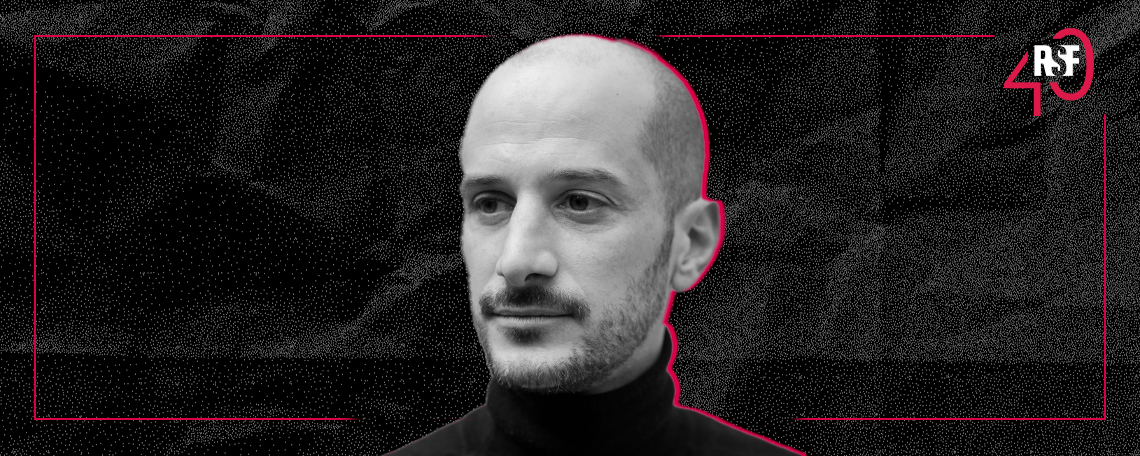 Anthony Lallican. Photo: RSF
Antoni Lallican and Heorgiy Ivanchenko — both experienced freelance war‑zone photojournalists — were accompanying the Ukrainian army’s 4th Tank Brigade near Komychouvakha, a town southwest of Kramatorsk in eastern Ukraine, to report on the construction of fortifications in the region.
 Distance from Komychouvakha to the front line (east). Source: Deepstate
 Distance from Komychouvakha to the front line (south). Source: Deepstate
According to the RSF investigation, soldiers accompanying the journalists were alerted several times to drone activity in the vicinity, prompting the group to shelter before resuming work a short time later. Shortly before 9:30 a.m., a Russian FPVі drone — a small device fitted with explosives and a camera that transmits live images to the operator — flew over the group and struck. At the time of the attack, both photojournalists, wearing helmets and bulletproof vests marked “press”, were in the open; their vehicle was parked several hundred metres away.
The strike killed Antoni Lallican instantly and gravely wounded Heorgiy Ivanchenko. Ivanchenko was evacuated for emergency care and subsequently underwent a leg amputation; he remains hospitalised. Three other civilians were also present — reportedly working on fortifications.
Ukrainian authorities opened a preliminary war‑crime investigation the same day, which was assigned to the regional prosecutor’s office in Donetsk. Two days later, on October 5, France’s National Anti‑Terrorist Prosecutor’s Office (PNAT) announced a separate investigation, handled by the Central Office for Combating Crimes against Humanity and Hate Crimes.
“Killing journalists — who are protected under international law — is a war crime. Based on RSF information, this was a deliberate attack that took the life of Antoni Lallican, an accomplished independent photojournalist, and left his colleague Georgiy Ivanchenko with irreversible injuries. The investigations opened in France and Ukraine must establish full accountability and identify those responsible for this strike. Since the Kremlin’s full‑scale offensive in 2022, fourteen reporters have been killed in Ukraine. These crimes must end,” Thibaut Bruttin, the RSF Director General, said.
The RSF pointed out that Russian propaganda quickly seized on the attack. On several pro‑Kremlin websites and Telegram channels, Antoni Lallican was smeared as a “propagandist” — a recurring accusation used to discredit professional journalists covering the war against Ukraine.
On October 4, the Russian “volunteer” FPV‑drone unit Sudoplatov, which also circulates videos of FPV strikes, posted on its Telegram channel an instruction to aim systematically at the windscreens of military vehicles operating in the area. The post added an overt threat: “PS: if a French ‘journalist’ recruiting foreign mercenaries for the Ukrainian armed forces is in a military vehicle, aim at the windscreen too!”
“This smear campaign seeks to delegitimise the independent work of the photojournalist and to downplay the targeted nature of the strike against civilians,” the RSF statement reads.
For reference: Since 2022, Antoni Lallican covered Russia’s full‑scale invasion of Ukraine for the photo agency Hans Lucas and for French and international media, including Le Monde, Le Figaro, Mediapart, La Croix, Libération, Paris Match, as well as German outlets — Der Spiegel, Die Welt — and the Swiss daily Le Temps. His work earned him, among other distinctions, a nomination for the RSF Photo Award in 2024.
Heorgiy Ivanchenko, based in Kharkiv, is a member of the Ukrainian Association of Professional Photographers (UAPP) and collaborates with Ukrainian outlets such as The Kyiv Independent and Babel, as well as with international media, including Libération.
On October 6, photographer Olha Kovalyova stated that Heorhiy Ivanchenko had his leg amputated after sustaining a severe injury while performing professional duties.
“During his work on the front line, Heorge sustained a severe injury, lost a lot of blood, and doctors were forced to amputate his leg. Ahead are a series of operations, prolonged rehabilitation, and prosthetics. We are raising funds for urgent treatment, postoperative care, and rehabilitation. Every amount matters,” she wrote on Facebook and published ways to donate in monobank and PayPal: ukrainianphotographers@argentum97 .