Russian attacks kill nine Ukrainians on August 20
Date:
21 August 2025
Add ZMINA as a source on Google
Nine civilians were killed and at least 11 others were injured in the Donetsk, Dnipropetrovsk, Kharkiv, Kherson, and Zaporizhzhia Oblasts as a result of Russian military strikes on August 20, 2025, the National Police of Ukraine reported.
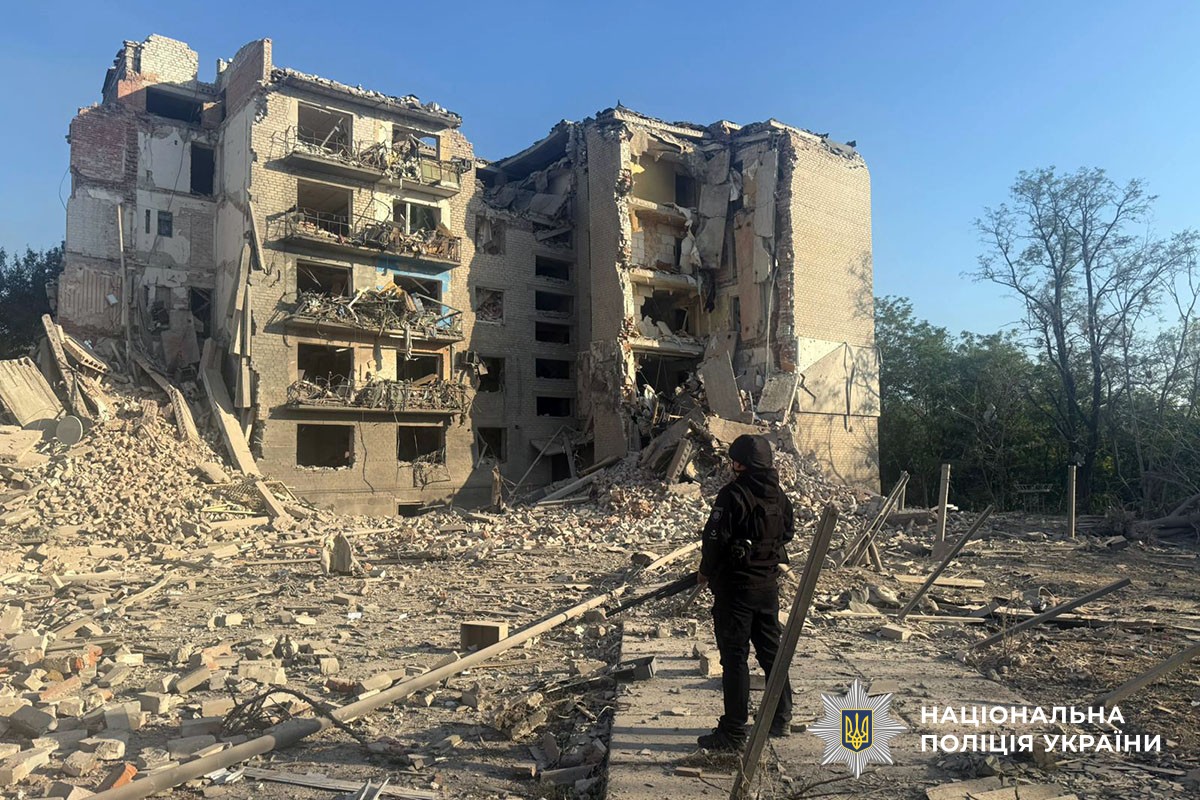 A police officer in the Donetsk region looks at an apartment building destroyed by Russian shelling
Fatalities were reported in all five regions, which are consistently featured in the daily police summaries of the war’s impact.
The highest death toll was in the Donetsk region, where the Russian army killed three people in the frontline town of Kostiantynivka. The city was shelled throughout the day with drones, guided aerial bombs, and multiple launch rocket systems, which also left four people wounded. About 6,800 civilians remain in this city despite constant Russian attacks, Vadym Filashkin, head of the Donetsk Oblast Military Administration, stated during the national joint 24/7 newscast.
An additional person was injured in Kramatorsk, and another in Bilozerske.
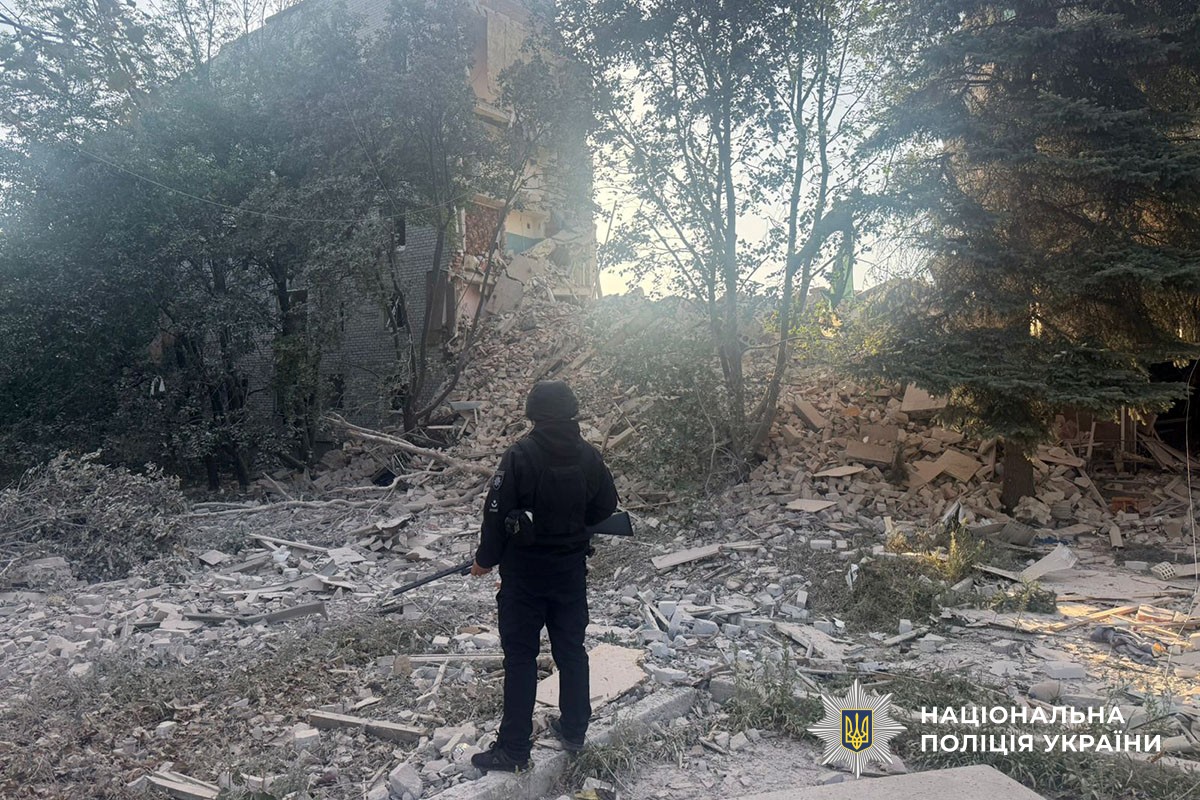 A police officer in the Donetsk region looks at a high-rise building where an entrance section has collapsed due to Russian shelling
In the Kharkiv region, as well, two people were killed – an elderly couple whose car was hit by a remotely operated Russian drone near the village of Petrivka. Other shelling was recorded in the region, but it resulted in no further casualties.
 The body of a woman killed in the Kharkiv region lies on the road near the car shelled by Russians, in which her partner also died
Two civilians were also killed in the Kherson region on August 20.
One victim was a 39-year-old man from Bilozerka who was in his yard during a morning artillery strike. The daily summary also included the death of an 80-year-old man who succumbed to injuries sustained during a Russian attack on a bus on August 9.
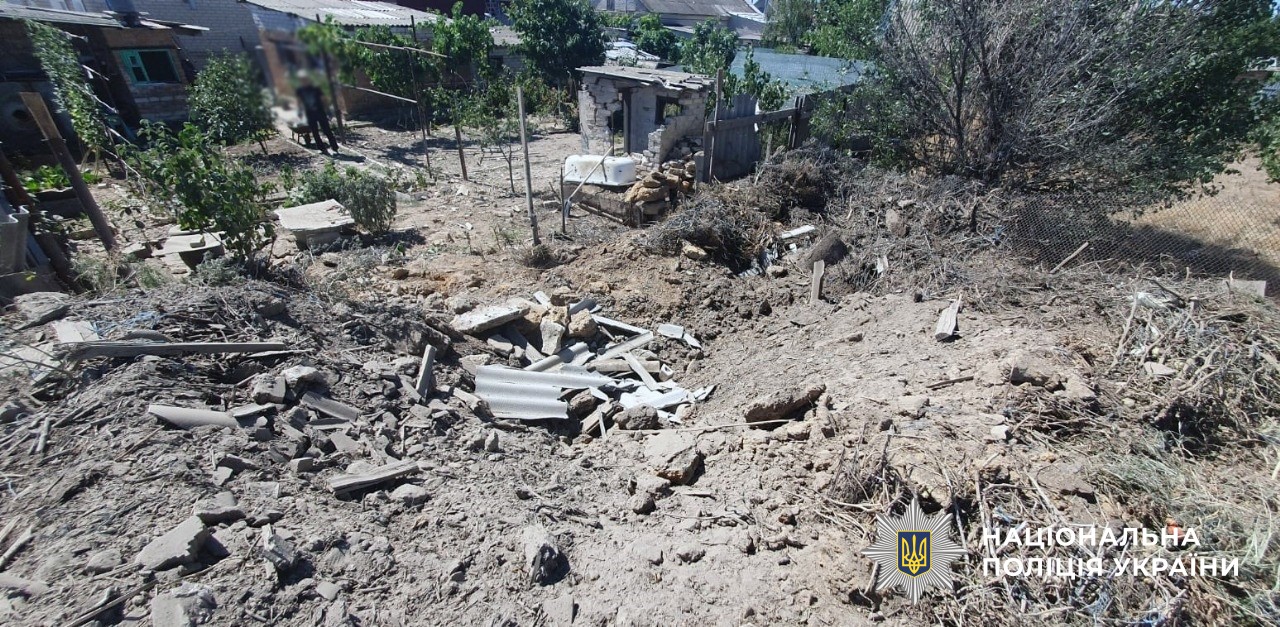 The yard of a private home in the Kherson region that came under Russian shelling on August 20, 2025
In the Zaporizhzhia and Dnipropetrovsk regions, Russian forces killed a total of two people and injured three others over the course of the day.
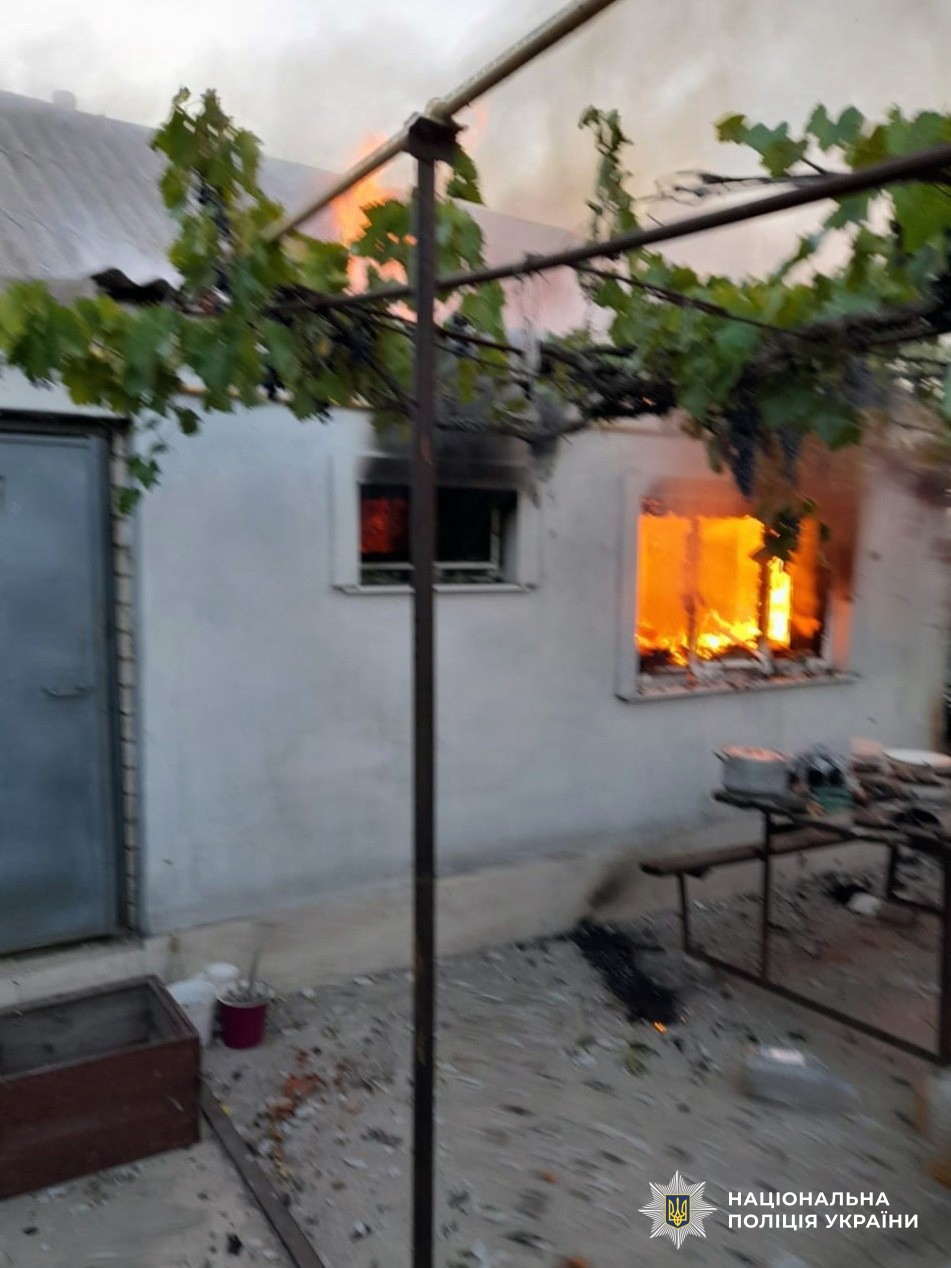 A private home in the Kherson region burns following a Russian shelling attack on August 20, 2025
Ukrainian Air Force reported that Russia launched 614 air targets against Ukraine Tuesday night, and Ukrainian air defenses downed 577 of them.
From 6:40 p.m. Tuesday, Russian forces attacked Ukraine with:
- 574 Shahed-type attack UAVs and decoy drones launched from the Russian cities of Kursk, Bryansk, Millerovo, Oryol, Shatalovo, and Primorsko-Akhtarsk, as well as from Russian-occupied Hvardiiske in Crimea;
- Four Kh-47M2 Kinzhal aeroballistic missiles were launched from Russia’s Lipetsk and Voronezh regions;
- Two Iskander-M/KN-23 ballistic missiles were launched from Russia’s Voronezh region;
- 19 Kh-101 cruise missiles launched from Russia’s Saratov region;
- 14 Kalibr cruise missiles launched from the Black Sea;
- One unidentified missile was launched from the temporarily occupied Crimea.
The attacks continue a deadly trend. On August 19, Russian shelling killed eight people in Ukraine, with more than a dozen injured, including children and doctors.
Amid discussions about a potential peace settlement in Ukraine, Russian forces have intensified their shelling, leading to a sharp increase in civilian casualties. In some regions, the number of attacks has reportedly increased tenfold.
Earlier, Bohdan Bernatskyy, a member of the Sanctions Policy Working Group of the Crimean Platform Expert Network, revealed at the Third Parliamentary Summit in Latvia that over 1,300 Russian military companies and two million industrial workers continue to operate, many without international restrictions.
It has been identified that several countries, including China, North Korea, Hungary, Slovakia, Iran, and Brazil assist Moscow in killing Ukrainians in its war against Ukraine by funding the Russian budget through trade.
Western intelligence agencies and media outlets have increasingly documented a sophisticated network of Chinese technology transfers bolstering Russia’s military capabilities in Ukraine. According to assessments from US Director of National Intelligence Avril Haines, made on May 2, 2025, China has helped shift momentum in Russia’s favor in the Ukraine war by providing Moscow with technology.
The technology pipeline operates through dual-use exports—civilian technologies with military applications. These include advanced semiconductors, precision manufacturing equipment, and communications technology that Russian forces are incorporating into weapons systems and battlefield communications. Unlike direct military aid, these transfers occur through legitimate commercial channels, making them difficult to track and sanction.
China continues to purchase Russian oil, funding Russia’s military budget. Reuters reported that refineries in China are actively purchasing Russian oil, taking advantage of the opportunity to acquire petroleum products at discounted prices, which India has refused to purchase due to pressure from Washington.
Meanwhile, Reuters reported that U.S. Treasury Secretary Scott Bessent accused India of profiteering from its sharply increased purchases of Russian oil during Russia’s war in Ukraine, saying Washington viewed the situation as unacceptable. Bessent told CNBC in an interview that Russian oil now accounted for 42% of India’s total oil purchases, up from under 1% before the war, and contrasted that with longtime buyer China, whose Russian oil purchases had increased to 16% from 13%.
Reuters also reported that Indian refiner Nayara Energy, backed by Russia and under European Union sanctions, is relying on a dark fleet to import oil and transport refined fuels, according to shipping reports and LSEG flows. Nayara, which controls about 8% of India’s 5.2 million barrel-per-day refining capacity, has been struggling to transport fuel since being placed under EU sanctions in July. This move prompted shippers to back out, forcing the refiner to cut its crude runs.
Want more insight from Ukraine’s human-rights story? Follow ZMINA on X and LinkedIn – and share what matters to you via this short survey here.