Russia kills 47-year-old man in dawn artillery attack on Komyshany, Kherson Oblast
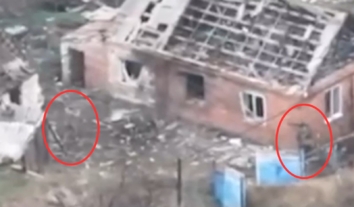
The Russian military killed a resident in an artillery strike on the village of Komyshany in Kherson Oblast at around 5 a.m. on June 30, 2025, according to the Kherson Oblast Prosecutor’s Office and Oleksandr Prokudin, head of the Kherson Oblast Military Administration.
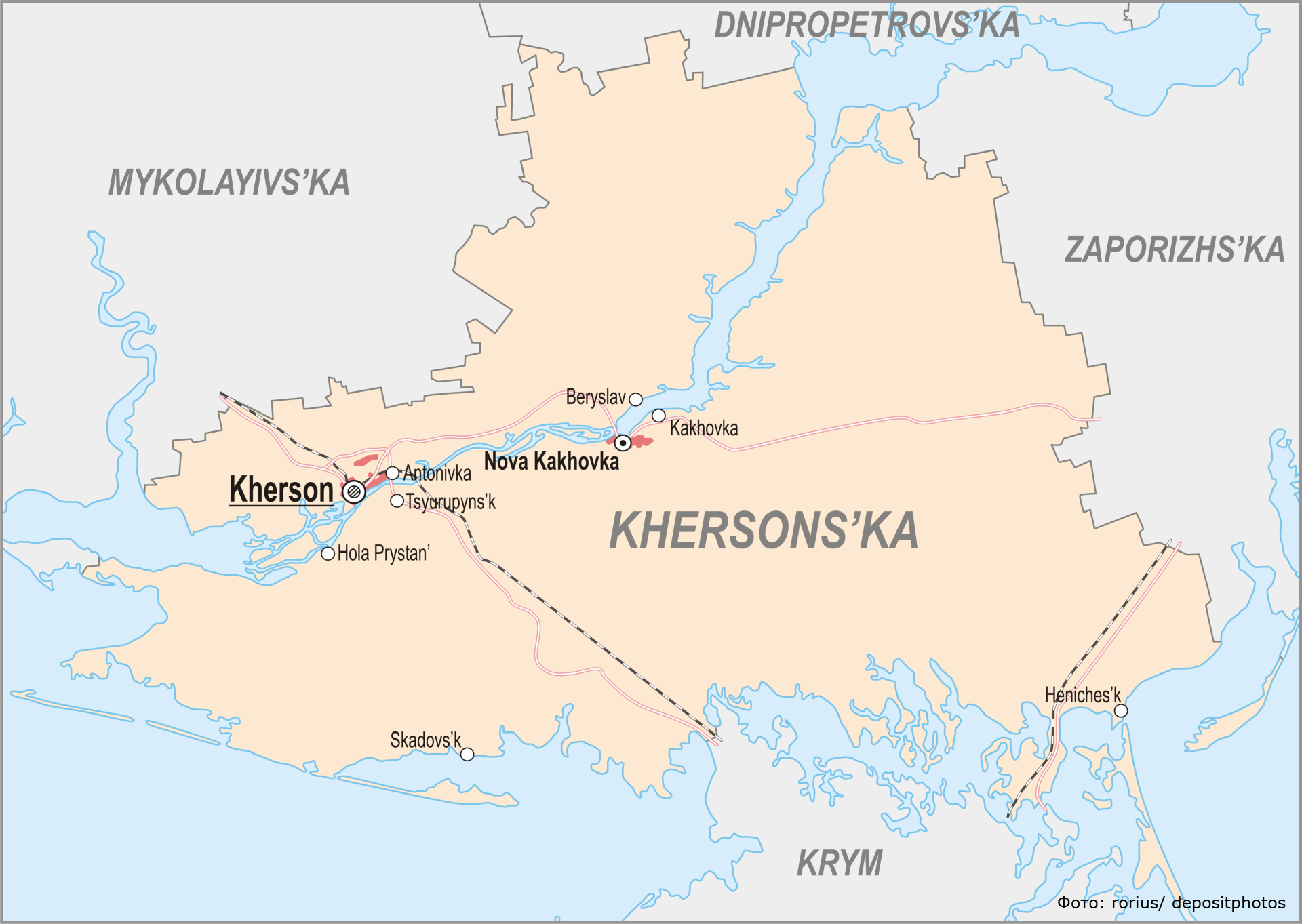
In that attack, Russians killed a 47-year-old man who sustained fatal injuries.
Prokudin reported that over the past day, Russian forces subjected 28 settlements in the oblast and Kherson to enemy drone terror”, artillery strikes and airstrikes. He writes about two killed people.
Russian forces targeted social infrastructure and residential areas of settlements across the oblast, damaging a high-rise building and 17 private houses. The occupiers also destroyed gas pipelines, cell towers, farm buildings, a warehouse and a garage.
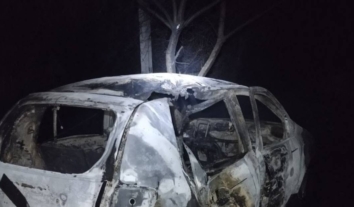
Prokudin also reported that a Russian drone attack on the city of Kherson at approximately 11 a.m. on June 30 injured one person and completely destroyed a car.
“Russian forces attacked the central district of Kherson with a drone at approximately 11 a.m. The enemy strike destroyed one vehicle and damaged another. A 51-year-old man is currently hospitalized,” he wrote.
The man suffered shrapnel wounds to his back and burns to his legs.
Prokudin also reported that a 67-year-old woman from Kherson’s Korabelnyy District had died from fatal injuries sustained in a Russian attack on June 29.
By way of background, the Russian Federation systematically attacks Ukrainian regions, including in the Kherson Oblast.
Russian attacks on Kherson Oblast killed one civilian and injured three others on June 27, according to Prokudin.
He also reported that Russian forces had launched airstrikes and used drones and artillery to attack the settlements of Antonivka, Naddniprianske, Sadove, Prydniprovske, Stepanivka, Molodizhne, Komyshany, Chornobaivka, Bilozerka, Tomyna Balka, Veletenske, Kizomys, Dniprovske, Myroliubivka, Novodmytrivka, Darivka, Poniativka, Mykilske, Tokarivka, Stanislav, Sofiivka, Shyroka Balka, Beryslav, Novoberyslav, Mylove, Respublikanets, Dudchany, Kachkarivka, Tiahynka, Lvove, Burhunka, Virivka, Chervonyi Maiak, Novooleksandrivka, Havrylivka, Zolota Balka, Osokorivka, Shevchenkivka, Khreshchenivka, Vesele and Kozatske and the city of Kherson that day.
Russian military targeted critical and social infrastructure and residential areas in the oblast. The attacks damaged a high-rise building and 26 houses. Russian forces also destroyed gas pipelines, garages and cars.
Prokudin reported that Russian forces had attacked a 48-year-old man in the Dniprovskyy District of Kherson using a drone at around 6:20 p.m. on June 27. He suffered severe injuries and later died in the hospital.
On June 26, Russia carried out an airstrike on residential areas of the village of Tavriiske in the Bilozerka District of the Oblast, killing a 38-year-old resident in his home, according to the Kherson Oblast Military Administration and Prokudin.
Russian forces attacked the city of Kherson with artillery and drones starting the morning of June 22, killing at least one civilian, according to the Kherson Oblast Military Administration.
The drone strike injured a 46-year-old man when Russians dropped explosives from the UAV, causing a blast injury.
Subsequently, Russian forces bombarded residential areas in the Dniprovskyy District of Kherson.
The strikes injured three women: an 85-year-old and a 54-year-old suffered blast injuries, and another woman remained in serious condition.
Later, officials confirmed that a man died from injuries sustained in the Russian artillery strike. Authorities are establishing his identity.
On June 19, the Ministry of Energy reported that a Russian attack killed a “Khersonoblenergo” employee while he performed his official duties
“An enemy drone attack killed an energy sector employee — 38-year-old Oleksii Bevza, an electrical fitter for the substation service — in the Kherson region during the performance of his official duties,” the ministry said.
The ministry noted that Oleksii was carrying out restoration work after a previous shelling. He is survived by his wife and daughter.
On June 13, Prokudin reported that an 11-year-old boy died in the hospital from injuries when Russian forces attacked Bilozerka on June 11.
On June 13, the Russian forces dropped explosives from a drone on a resident of Bilozerka. The attack injured a 58-year-old man who suffered a blast injury and concussion and was hospitalized.
Russians also killed a married couple, a 56-year-old man and a 54-year-old woman, injured two other civilians, damaged high-rise buildings and other residential buildings in their attacks on Kherson on the night of June 6-7, according to Prokudin and the Kherson Oblast Military Administration.
A 65-year-old man suffered a blast injury and wounds to the head, neck, chest and forearm. A 60-year-old woman sustained injuries to her arm and collarbone.”
On June 6, Russian army personnel attacked an ambulance in the Bilozerka hromadaі that was responding to a call with a drone, injuring medics, according to the Kherson Oblast Military Administration.
The UAV injured two medical workers when Russians dropped explosive devices. Medical personnel hospitalized their colleagues.
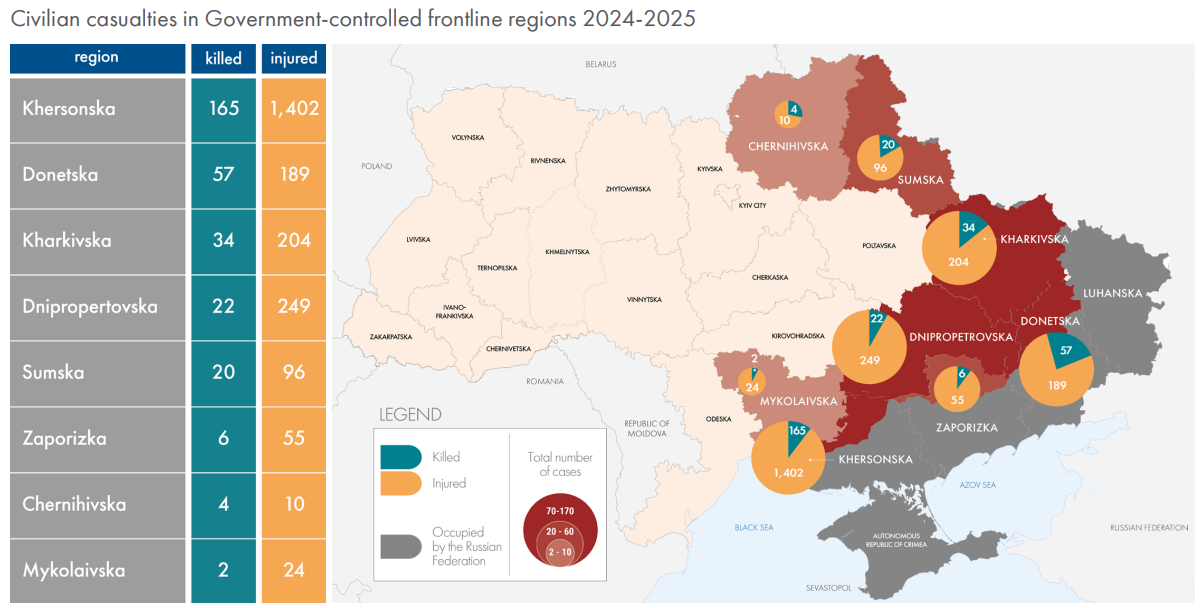
Previously, the UN Human Rights Monitoring Mission in Ukraine (HRMMU) issued a report in which HRMMU indicated that the Russian military increasingly uses FPV drones for targeted strikes on civilians in Ukraine.
The report stated that drones had become one of the leading causes of civilian casualties in Ukraine, surpassing, in some months, more powerful weapons such as missiles, artillery and aerial bombs.
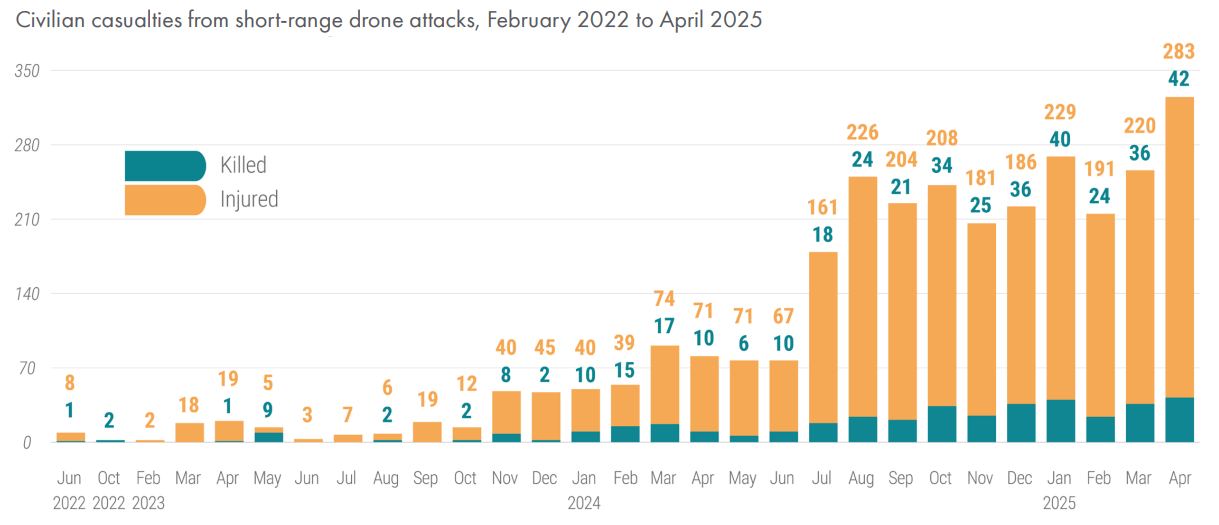 Infographics by the HRMMU
According to the UN’s analysis, Russian forces have deliberately attacked civilians who showed no signs of direct participation in hostilities. Among the casualties the HRMMU identified were civilians traveling by bicycle, in cars, on evacuation buses, in ambulances, during humanitarian missions, while walking or near their homes.
In addition to direct casualties, drone attacks prevent the delivery of humanitarian assistance. NGO workers, medical staff and public officials cannot move safely through affected areas, and the attacks deprive civilians of access to basic services, health care and food. Elderly people and persons with disabilities face the greatest impact as they remain in dangerous areas due to limited evacuation options.
On June 29, Slovak Foreign Minister Juraj Blanár stated that resolving Russia’s full-scale invasion of Ukraine requires re-establishing communication with Moscow, Slovak news agency TASR, with reference to STVR reported. He also stated that the West must find a way to cooperate with Russia and “perhaps even forgive everything that has happened.”
Ukrainian Foreign Minister Andrii Sybiha reminded Blanár X (Twitter) that “a sense of impunity is the root cause” of Russia’s crimes.
“It’s naive to expect a criminal to stop if their crime is forgiven instead of punished. Russia will hit your other cheek as well,” the Minister wrote.
Sybiha also added that those “who have lost no one in this war have no right to make such statements.”
A diplomat from one of the key EU countries, on condition of anonymity, told a European Pravda news outlet that Slovakia and Hungary are blocking the 18th package of European Union sanctions against Russia on June 27.
Slovakia is blocking the sanctions in order to obtain guarantees from the European Commission regarding the consequences of completely abandoning Russian gas from 2028.
Hungary, as the European Pravda source said, did not put forward any specific conditions.
The diplomat expressed confidence that discussions on the 18th package of sanctions at the level of EU ambassadors would not resume before the European Commission delegation’s visit to Bratislava on 3 July.