Three dead, nine injured as Russian missile hits Sumy industrial facility
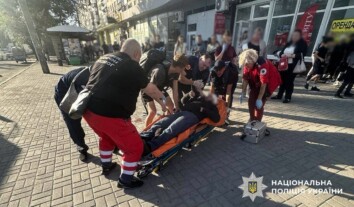
An explosion shook Sumy on the afternoon of May 14, 2025, as Russian forces struck an industrial infrastructure facility, according to the Sumy City Council, Artem Kobzar, acting Mayor of Sumy, the Sumy Oblast Military Administration and Serhii Kryvosheienko, Head of the Sumy City Military Administration. As of now, reports indicate three fatalities and nine injuries. Two injured people remain in serious condition.
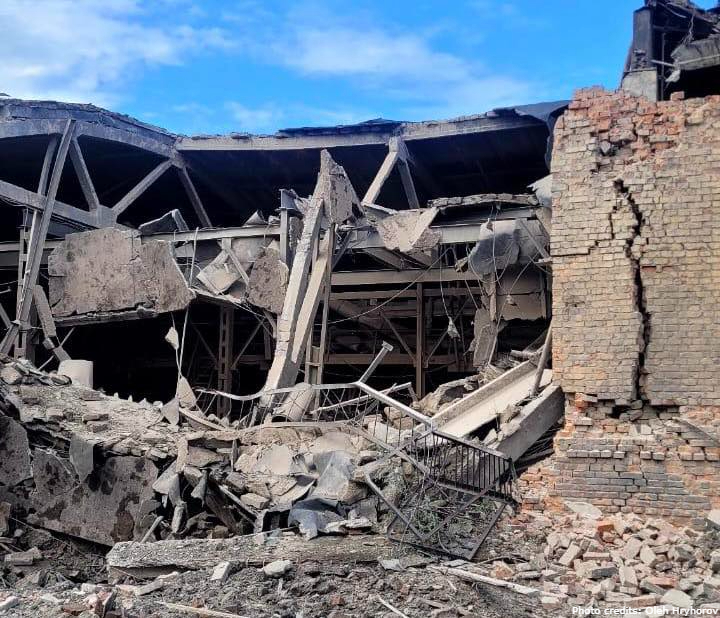
The Sumy Oblast Military Administration confirmed that Russia launched a missile strike on an industrial infrastructure facility in Sumy.
The city council reported that the Russian attack on the facility killed three people and severely wounded two others. According to the head of the Regional Military Administration, Oleh Hryhorov, the deceased were 36, 29, and 41 years old.
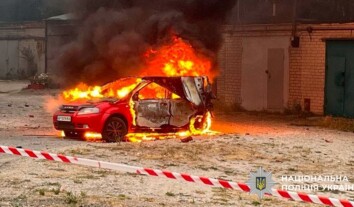
Earlier on May 14, a Russian drone struck a truck in the Sumy hromada, killing one person and injuring two others.
On May 12, a Russian drone attacked a car carrying power engineers in the Sumy Oblast, killing the driver and injuring three others.
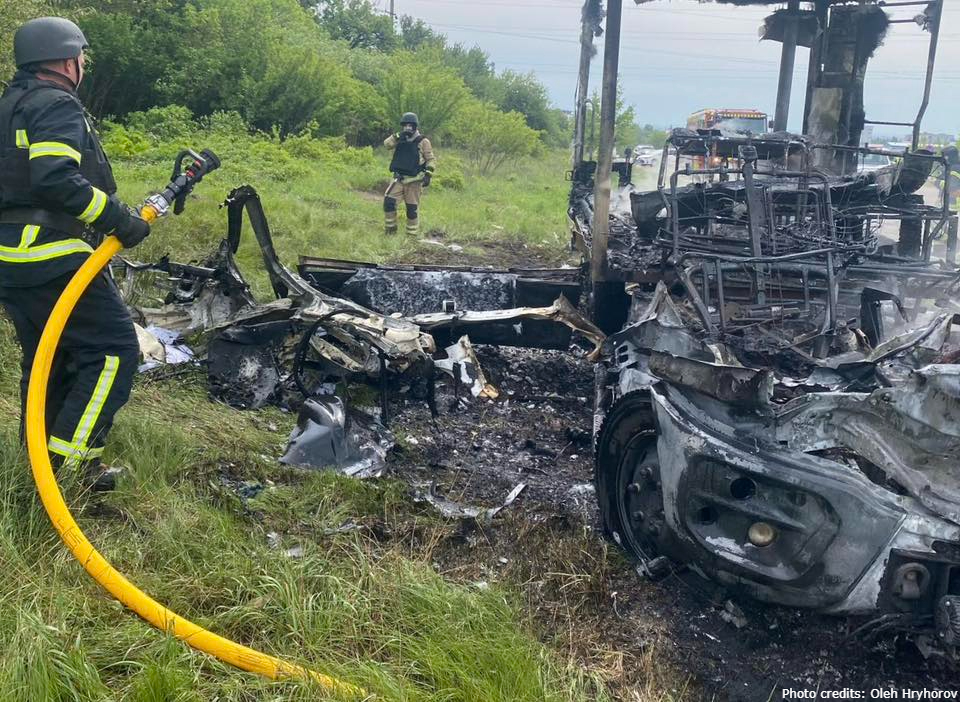
The Prosecutor’s Office in Sumy Oblast confirmed that the Russians had attacked a vehicle belonging to Sumyoblenergo [an oblast electricity distributor – ed.], which was moving through the Sumy hromada. A 44-year-old driver was killed, and three other employees of the company were injured.
ZMINA continues to report on ongoing international crimes in the Sumy Oblast.
Previously, Bohdan Bernatskyy, a member of the Sanctions Policy Working Group of the Crimean Platform Expert Network, revealed at the Third Parliamentary Summit in Latvia that over 1,300 Russian military companies and 2 million industry workers continue operating, many without international restrictions.
On May 12, the Main Intelligence Directorate of the Ministry of Defence of Ukraine (DIU) published technical details of the new Russian S8000 “Banderol” cruise missile on the War&Sanctions portal.
Their research shows that the missile’s developer is the sanctioned enterprise Kronstadt. This company also manufactures the UAV Orion, which is Banderol’s main carrier. According to the DUI, the product is being adapted for use in Mi-28N attack helicopters.
According to the DIU, these foreign components have been identified in the Banderol missile:
- Swiwin SW800Pro jet engine (China) – an engine for aircraft modeling, which is even sold through online platforms (estimated cost on AliExpress – $16 thousand);
- Australian-made RFD900x telemetry module or its Chinese copy;
- inertial navigation system, probably of Chinese origin;
- Murata batteries (Japan);
- Dynamixel MX-64AR servo drives (Robotis company, South Korea);
- interference-protected CRP antenna Comet-M8 (Russian Federation, “VNIIR-Progress”), which is also used in Geran drone, Universal Module of Gliding and Correction, Universal Inter-service Gliding Munition;
- Almost two dozen microchips from American, Chinese, Swiss, Japanese and South Korean manufacturers.
“Most of the foreign electronic component base for this missile comes through the ‘chip and dip’ network – one of the largest Russian electronics distributors,” the DIU noted.
On May 9, Ukraine’s President Volodymyr Zelenskyy enacted the National Security and Defence Council’s sanctions against 58 Russian citizens and 74 companies, most of which are linked to Russia’s defence-industrial complex,
Interfax-Ukraine reports. The sanctions list also includes three companies from Iran, three from Uzbekistan, and one from Hong Kong (China).
The restrictive measures were adopted by the National Security and Defence Council of Ukraine and subsequently enacted by a presidential decree.
On May 1, Zelenskyy enacted the NSDC’s decision to impose sanctions on Novatek, Russia’s largest liquefied natural gas (LNG) producer and one of the largest natural gas producers in the Russian Federation.
Sanctions have been applied to 5 individuals and 36 legal entities. Specifically, the NSDC sanctions list includes PJSC Novatek, owned by Russian billionaire Leonid Mikhelson, and its subsidiary companies (Novatek-Energo, Novatek-Ust-Luga, Novatek-Tarkosaleneftegaz, Novatek-Yurkharovneftegaz, Novatek-Murmansk, Obsky Gas Chemical Complex, Obsky Ammonia, Novatek-Transservice, Arctic LNG 1, Arctic LNG 2, Arctic LNG 3, Murmansk LNG, Yamal LNG, Yamal Trade Pte. Ltd., Arctic Transshipment, as well as the Swiss company Novatek Gas and Power GmbH and the Singaporean Novatek Gas & Power Asia Pte. Ltd.).
Moreover, sanctions have been applied to PJSC Novolipetsk Steel (NLMK), owned by Russian businessman Vladimir Lisin. It is Russia’s largest steel producer.
Several other plants, industrial complexes, and the “Russian Union of Industrialists and Entrepreneurs” were also sanctioned.
Previously, the Financial Times reported that Spanish Inditex, which owns the brands Zara, Bershka, and Pull & Bear, had exited Russia in a way that effectively allowed it to retain control and the possibility of return.
In October 2022, Inditex sold its Russian subsidiary, now named New Fashion, to the Lebanese Daher family. They already hold a franchise for selling Inditex products in the Middle East. A month before the deal, the family established a company in the UAE called Mixed R — it was this company that officially bought the business.
Before finalizing the sale, Inditex wrote off a loan of 9.1 billion rubles (approximately $120 million) previously issued to its subsidiary in Russia, and transferred another 5.7 billion rubles (about $75 million) to it. After this, the company was sold for a “negligible” sum.
After the deal, new brands — Maag, Dub, Ecru, and Vilet — replaced Zara, Pull & Bear, Bershka, and Stradivarius in 243 stores. They sell nearly identical clothing, and the suppliers have remained the same.
Some Inditex designers, managers, and buyers moved to the UAE and work in the business that the Spanish company refers to as the “Daher Group.” Such a company officially does not exist, but it operates through Mixed R.
“‘The aim of the deal was the sale of our business… while preserving the possibility of returning to the market through a franchise agreement,’ Inditex said in an official statement.”